Showing posts with label panasonic lumix tz30. Show all posts

Monday, 5 February 2018

Snowdrops

This is forecast to be the coldest week of the winter so far. This morning I had to clear a thin layer of ice from my car windscreen and drove through flurries of snow on my way across Norfolk. Yet by lunchtime the sky had cleared and it was a bright but cold day.

In the Rosary Cemetery I paused on my lunchtime walk to take some photographs of the Snowdrops these has naturalised here and there are great clumps of them, splashes of white petals in lieu of the patches of snow which never settled earlier in the day.

I always love it when there is a sense of a season turning, being elbowed out of the way by its impatient successor and today's show of Snowdrops tells that Spring is starting its inexorable push to succeed winter.

Snowdrops, Rosary Cemetery, Norwich

Monday, 29 January 2018

Light

December is a month of short dark days, weeks that compete for gloominess and a month that seems to shudder to a halt with the indoor excesses of Christmas. Yet just a week or two later as the days  start to draw out in the new year there is a also a subtle change to the quality of the light. Now on sunny days it has a vibrancy that was missing in December and comes with a gentle hint of the Spring to come. 

Ken Hill Woods last Friday, I quite liked the light
Last Friday was just such a day of promise, a clear night left a heavy morning frost that coated the cars windscreen with a thin layer of ice. In the local woods at lunchtime a bumblebee sat in a stupor on the ground woken to early from its winter sleep, the vibrant yellow flowers of a Gorse bush were out a little early for pollinators like the unfortunate bee. As I enjoyed my walk snatches of Great Tit and Nuthatch song cut through the trees, whilst a large mixed flock of Long Tailed Tits, Goldcrests and Coal Tits reminded me that this was still January.

But it was something about the light on a woodland ride and how it brought out the colours of the bare trees that made me stop in my tracks and pull out my little compact camera. To the left of the ride sunlight streamed through a gap in the trees, creating a natural spotlight at 45 degrees. This light hit the bronze leaf litter on the forest floor and reflected back up onto the white bark of the silver birches that edged the ride. Behind all this a belt of conifers suffused with the same winter light gave a soft green background to the scene.

This viewpoint is one that I have passed many times before, it is on one of my favourite walks through these woods, a walk I do probably at least once a week throughout the year. It is pleasant but it doesn't normally having me pausing and reaching for my camera. But today what for me briefly lifted the scene was the light helping me see a different view and bringing this bend in a path in the woods to life.


As I stood and tried to capture an image that would go someway to capture the spirit of the scene in front of me, I was acutely aware of the transient nature of what I was enjoying. All it would take for the magic to fade would be a change in the position of the sun as the afternoon wore on, or a light breeze pushing in some cloud and with it turning off the magical soft winter light.

I carefully composed my image and pressed the shutter button, then after taking one last look at the scene in front of me continued my walk around the wood and eventually back to my office and a full afternoons work at my computer.

Sunday, 6 March 2016

A storm lit Peregrine

Yesterday was a cold day with grey sky's and a northerly wind blowing in frequent icy showers. Also a family day with kids swimming lessons and meals to prepare and supervise. But just after 4.30pm I felt a need to experience a bit of wildness and so I seized the opportunity offered by a gap in the weather for a walk under Hunstanton cliffs. 

When I got down onto the beach the first thing that struck me was the large numbers of slightly flighty Oystercatcher's feeding among the boulders on the tide line, these were noticeably focused on eating bivalves and I saw several with mussels and winkles in their beaks. 

Oystercatcher's Hunstanton Beach
As I watched the Oystercatcher's, Fulmar's like stiff winged crosses, glided effortlessly over the sea and across the face of the cliffs they will soon be nesting on.
Looking north along Hunstanton Cliffs and into the approaching storm

A curtain of rain back lit by the setting sun hung across the Lincolnshire shoreline of The Wash. To my north a slate grey sky gave an electric light to the horizon. And it was cold enough for me to be wearing gloves and swap my baseball cap for a warmer fleece hat.

An insouciant dog walker passed with his hounds which flushed the feeding waders and a small party of Brent Geese, creating for a moment or two a wheeling wind blown confusion of wings and bird calls. Looking up the grey sky to my north seemed closer. 

As the shorebirds settled I stood on a low boulder and picked out the unmistakable cigar shape of a Peregrine coming up from the south and over the sea heading towards me.  In the storm light as it powered its way into the wind effortlessly ahead of the ineffectually mobbing Herring Gulls its body glistened like Mercury.  

Then with the sun below the horizon and the storm upon me came the darkness and accompanying cold sharp rain.

The waters of The Wash and the sky above me were by now similar shades of dark battleship grey, the northerly wind on its own would have been bitterly cold but now this was amplified by the driving ice cold rain that was hitting me in the face. I'd had and savoured my wild moment and now I turned and strode with the wind at my back for home. 

The storm over me, Hunstanton Beach

Sunday, 21 February 2016

Winter sunshine on Titchwell and Roydon

Thursday 18th February, had a great day in the field.

If I have a problem with Titchwell Marsh it is that I know it so well, I have been visiting this site on the north Norfolk coast ever since I moved to Norfolk in the late 90's and sometimes it is difficult to see the place with fresh eyes, I know where the Woodcock will be, where to look for a Water Rail when to expect the Avocet flock to start building in late winter and so on. So visiting with my young family is a great chance to slow down and try and see the place through the eyes of two small boys one aged six and the other four.
Water Rail at Titchwell, Panasonic Lumix TZ30
Last Thursday was a great opportunity to do just this. The boys, my wife and I arrived mid morning and walked from the car park to the beach and back. It was a beautiful, crisp blue sky day, perfect for walking and any birds would be a bonus. As we hit the start of the West Bank path I noticed a couple of birders staring intently into an overgrown ditch a pretty good sign that a Water Rail was showing and sure enough there was one feeding out in the open and both boys were able to see this only six feet away and without binoculars. As one old boy said to them you're really lucky I had to wait 40 years to see one [not sure if he meant 40 years of age or 40 years of birding].

As the path leaves the wet woodland it skirts the edge of the reed bed and a series of small pools and ditches. Just ahead of the family I picked up a Kingfisher flying into a sallow and was able to set the scope up on it. Amazingly it sat there for several minutes allowing both kids to get good views of it. The Kingfisher even hovered over the pool for us.
Kingfisher at Titchwell, hand held Panasonic Lumix TZ30 through a Kowa 883
After a visit to the beach we walked back to the car stopping for no1 son to admirea very close Black Tailed Godwit and then back in the wood by the car park I stopped with no2 son who was transfixed by one of the very tame and approachable Robins.

Later that afternoon having dropped the family off at home I popped down to Roydon Common for the Harrier roost. The car park was as full as I have ever seen it and about 40 folk stood on the path that runs along the southern edge of the depression that makes up the middle of the Common. Whilst we waited for the Harriers to come into roost I searched for whatever else was on show, this was hard work but I did manage a couple of common Buzzards in a dead tree, a distant hunting Barn Owl and half a dozen Roe Deer.

Then as the heat left the afternoon as the sun dropped behind the hill to our rear the first ring tailed Hen Harrier drifted in across the common. A little later the bird we'd all been waiting for appeared a Pallid Harrier although always distant it gave great scope views as it flew over the browns and yellows of the common and the backdrop of fringing bare branched silver birches, and would perch on a fence post for minutes at a time. At one stage it spent a minute or two chasing and being chased first by a Hen Harrier and then by a Carrion Crow and at one point put up a Jack Snipe from a wet patch.
Pallid Harrier hand held Panasonic Lumix TZ30 through a Kowa TZ30
As the light started to ease away more Hen Harriers drifted int and I saw at least three perhaps four ringtails and there was still time for more birds to come into roost when I left with cold hands and feet.
Roydon Common at Twilight, Panasonic Lumix TZ30

Sunday, 22 November 2015

Brief encounter with a Kingfisher

The weather has turned and the last hint of Autumn is behind us and this is now winter. Yesterday we had bitter cold gusting north westerly winds blowing over the bins in people front gardens in Hunstanton and providing birders on the east coast with a few Little Auks to enjoy.  By this morning the wind had dropped and there was a blue sky over the town, in my case I could see it from the windows of the Oasis leisure centre where I was attending no2 sons 4th birthday party.
Kingfisher, Holme Marsh
By this afternoon the weather had closed in again and grabbing the chance for an hours fresh air I headed to Holme Marsh where I figured I'd have the place to myself and the shelter of the hides if I needed it.
Cropped Kingfisher image, Holme Marsh
It was good to see the reed and Typha had been cleared from in front of the first hide and from here I saw a Cettis warbler in brief partial glimpses as it worked its way through the base of some reeds. A Barn Owl put in a brief appearance and I then decided to look from the second Hide, here the best birds were a male and a female Marsh Harrier hunting the NWT reserve. Then the high pitched call of a Kingfisher had me looking hard out of the hide window as a bird landed on a Typha head in front of the hide, its blue back and orangey underside doing their best to brighten a dull afternoon. I grabbed my compact camera [a Panasonic Lumix TZ30] and managed a few shots of the perched bird, not bad results for something the size of cigarette packet. The Kingfisher departed and in its place came rain, lots of it hitting and pock marking the surface of the pool. Time to head home.

Saturday, 14 November 2015

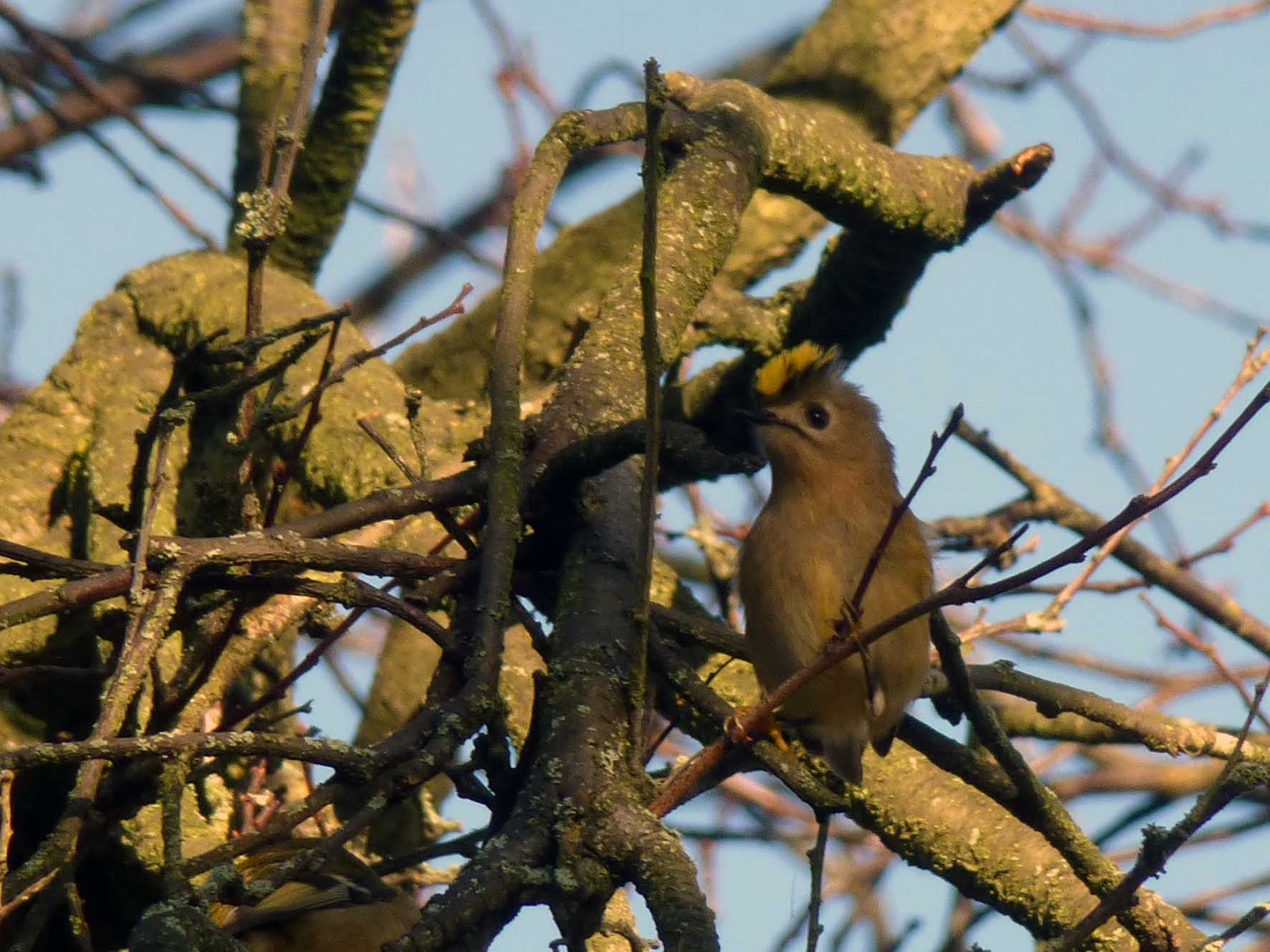
Goldcrest's for Lunch

The east coast deluge of Goldcrest's is over. Just a few weeks back vast numbers of these tiny warblers could be found in almost any piece of seaside cover.

For such a tiny bird, they are smaller than a Wren, Goldcrest's are impressive little things with their orange or yellow crests, small needle bills and round black eyes set against olive green feathers. It can be hard to imagine such little bundles of feathers deliberately crossing the North Sea. Indeed an old colloquial name for Goldcrest was Woodcock Pilot the belief being that to cross the sea they'd hitch a ride on the back of a Woodcock, acting as a pilot for the larger, stronger but perhaps less intelligent bird.
Goldcrest, Rosary Cemetery, Norwich
So here I am on a mid November lunchtime in the heart of Norwich, its sunny and clear but the cold wind tells me that we have almost completed the transition from autumn into winter. A familiar set of chattering and high pitched bird calls has made me stop on the path beneath a couple of small trees that have nearly lost all of their leaves. In them are a mix of small birds Blue, Great and Long Tailed Tits are the most numerous and most obvious but a high pitched call and a couple of fidgety tiny shapes give away the presence of a couple of "Crests"

I start phishing, sucking air between my lips and teeth making a rasping, screeching sound almost guaranteed to bring in curious small birds for a closer look, something I'll need as I have no binoculars with me.

I want to get the Crests in close to check if one of them might be a less common Firecrest and also, well because I can, and to try and get a picture with my compact camera, which is not the best tool for the job.

As I phish a succession of small birds drop in for a look and eventually two small Goldcrests move to my side of the tree flitting and fidgeting through the bare branches whilst I try and get a shot. I can easily see from the views that I get that they are both Goldcrests and I even manage a couple of OK shots.
Goldcrest, Rosary Cemetery, Norwich
Time is pressing and my lunch break is nearly over and I need to retrace my steps through the overgrown cemetery and back to my office, I do so with a small smile of my face as m encounter with these small birds has given me a small birding fix for the day.

Wednesday, 17 June 2015

A brief encounter with the cemetery Sparrowhawks

Male Sparrowhawk, Rosary Cemetery, Norwich
The cemetery is at its leafy overgrown best as I walk up the hill through a green tunnel and past the terraced rows of Victorian gravestones many now draped in Ivy and surrounded by Bramble patches. The leafy green is now losing its early spring freshness and even the Ox eye Daisy's look a little tired today.

An insistent screeching call alerts me to the presence of the local Sparrowhawks and I pause to take stock. I've seen them in this corner of the cemetery before and have often suspected that they have a nest here. Excitedly my mind quickly goes over the possibility that they have nested here and if I am hearing recently fledged young soliciting food from their parents.

I stand still and scan the large Copper Beech and Oak in front of me. Then there she is a female Sparrowhawk flies out of the Oak and out of sight and yet still the insistent screeching call continues. I squint through the gently swaying branches and there he is a male Sparrowhawk standing on a thick horizontal oak bough and clasping a unidentifiable prey item in his talons, presumably to entice the female to come and see him should his calling not be enough to do the job.

A Jay squawks from a near by tree and then its pink purple shape flies across the ride pursued by the female Sparrowhawk, who once again disappears from view into the dense green summer canopy and still the male bird sits on his bough, grasping his prey item calling to her.

I'm a little amazed by this, normally if you can see a Sparrowhawk it means they have already seen you and are flying away from you, so to get prolonged and close views like this is a rare treat.

I take some pictures and video of the male with my little compact camera, a Panasonic Lumix TZ30 about the size of a fag packet and a very handy little toy to keep in my pocket for occasions like this. The female briefly joins the male on the bough. And then its over and the spell is broken by another lunchtime walker passing under the male sparrowhawks Oak tree, causing the hawk to fall silent and disappear from view. 


Thursday, 30 April 2015

Sunset snaps

I live in Hunstanton and regularly see people taking pictures of the sunset over The Wash cameras, phones and tablets held in front of their faces in supplication and I suspect 99% of the time capturing the same snap shot of a ball of fire descending into the sea.

I am occasionally tempted to take a picture like this and below is one that I think works due to the very simplicity and symmetry of the composition.

Wash sunset
But I like to try and get something a little more interesting and a few evenings back I went for a walk at dusk along Hunstanton Beach with my binoculars and little compact camera [a Panasonic Lumix TZ30], as much to stretch my legs and back as anything and with perhaps a vague hope of hearing and maybe seeing a newly arrived Sandwich Tern offshore.

As I filled the void left by the completely absent terns I played with my camera wondering how to make the setting sun part of a more interesting composition than just the cliched ball of fire setting into the sea. And then I saw this family strung out in a line and trudging homewards. I liked the fact there were three of them and how at the end of the day Dad was leading the way and followed by mum and child with their tired heads bowed, or at least that's what I read into the picture. Also liked the simple composition with lines of colour. And yes I know that the horizon isn't quite straight.

Home from the beach

Sunday, 1 December 2013

Squeezing in Squirrels, Gulls, BOPs & Pipits


Grey Squirrel, Rosary Cemetery, Norwich

It's been a pleasantly varied last seven days with some nice opportunities to do a bit of wildlife watching mixed into my working and personal week. I managed a couple of lunchtime walks arou8nd the Rosary Cemetery in Norwich earlier in the week and one of these coincided with some lovely light and a lot of Grey Squirrel activity as they foraged for food in the leaf litter.

Yellow Legged  and Lesser Black Backed Gulls, Titchwell Marsh, Norfolk
A two day work meeting close to home in NW Norfolk included some time out and about and I and my colleagues enjoyed a great couple of hours at Titchwell. I was particularly pleased at picking out this distant Yellow Legged Gull and a Merlin flying offshore. Other highlight were Red Necked Grebe, Marsh and Hen Harrier, Sparrowhawk, Cetti's Warbler, 35+ Little Egrets and a Chinese Water Deer on the Saltmarsh. I enjoyed watching this Black Headed Gull feeding on the Saltwater Pool.


Black Headed Gull, Titchwell, Norfolk


Little Egret, Burnham Overy Staithe, Norfolk
Today I took no2 son for a quick drive along the coast road to get him to sleep and I took advantage of this to nip into Burnham Overy Staithe and Brancaster Staithe Harbour's. Nice to see Marsh Harrier at both sites and to watch this Little Egret feeding at Burnham Overy Staithe.

Rock Pipit, Burnham Overy Staithe, Norfolk

Rock Pipit, Burnham Overy Staithe, Norfolk
It was good to pick up a couple of Rock Pipits at Overy Staithe.

All pictures taken with a digital compact Panasonic Lumix TZ30 so I can either apologise for the fuzzy cropped nature of some shots or invite you to marvel at what you can achieve with a camera that isn't much bigger than a fag packet, either way I didn't have my SLR with me at all this week so having  a compact meant at least I got some images.

Monday, 29 July 2013

Lunchtime Sparrowhawk

Heavily cropped shot of Sparrowhawk, Rosary Cemetery, Norwich


Original uncropped Sparrowhawk shot, Rosary Cemetery, Norwich
 Whilst I have only ever seen one Buzzard and one Kestrel during all my lunchtime walks around the Rosary Cemetery in Norwich, I reasonably frequently catch a glimpse of a Sparrowhawk.

This bird gave its presence away by constantly calling presumably to its mate for food and was [for a Sparrowhawk] remarkably tolerant of my presence. I think it may be a young bird but will have a bit of a look in some books and update this blog if that isn't the case. I've now had a look in my 'Collins Guide' and have change my mind the grey back colour [as opposed to brown in a Juvenile which should also have some white edging to its back feathers] and the uniform nature of its chest barring make me think this was a adult female.


Sparrowhawk, Rosary Cemetery, Norwich
 The pictures were taken with my Panasonic Lumix TZ30 and the top one cropped on the computer. Pretty impressive for a piece of kit that isn't much bigger than a packet of cigarettes.

Friday, 14 June 2013

Fox, Squirrel and Snake for lunch

Fox cub, Rosary Cemetery, Norwich
I've been away on holiday in Yorkshire and may eventually get around to a post or two about that trip. In the meantime a couple of interesting sightings from the last week.

One of my regular lunchtime walks through the Rosary Cemetery in Norwich was interrupted by a rustling sound from inside a bush, on peering in I saw the unmistkeable muzzle and ears of a fox cub which bolted and disappeared at which point I noticed the strong 'foxy' smell. On my walk back the same or a different cub ran down a path away from me and I managed the grab shot above.

Grey Squirrel, Rosary Cemetery, Norwich
Much more to be expected in the cemetery was this Grey Squirrel which posed nicely in a tree, they've been a little reliable in recent weeks so it was nice to see this one pose for me.

Grass Snake, Ken Hill Wood, NW Norfolk
Today I was working in Snettisham and managed a Red Kite from the office window and this Grass Snake during a very short walk in Kne hIll Woods. It was warmish today but a little overcast and I think because of this the snake was not as active as they often are here which enabled me to get quite close to it to take these pictures with my compact camera.

Friday, 24 May 2013

Things to do with Wood Pigeons


Add caption
Seeing the extraordinary in the day to day and common place is something that as I get older I think I am becoming better at doing. This is driven I think by two factors, firstly as I get older I think the sum of my life experiences means that how I see the world is perhaps more nuanced than when I was younger. Secondly and perhaps more importantly I am more restricted now in what I can and can't do by the demands of a young family and full on job, all of which means that I now need to get my birding and photographic kicks much more locally and in much smaller windows of time.
The picture at the top of this blog is an old one of a Wood Pigeon taken a few years ago on a day when I had plenty of time and was wending my way along the north Norfolk coast. I took it with a DSLR and a big lens and very nice it is too. But it wasn't the highlight of my day and I didn't set out with this image in mind, I saw it, I grabbed it, and I moved on.


The next image is the first of three that I want to share with you that show how I have adapted what I do and perhaps in the process become more creative and thoughtful about my photography and birding and perhaps as a consequence I am also producing more interesting images. Taken just after the sun had dipped below the horizon, it is of a Wood Pigeon perched on a post, on top of Hunstanton Cliffss looking across The Wash towards Lincolnshire. I live five minutes walk from this location and I'll often take a 20 minute evening stroll along the cliff tops and see visitors taking pictures of some spectacular sunsets.  But for me on there own most sunset images of sky and sea lack a certain something, a something that this Wood Pigeon image has a little of which is to mind a story and some structure and form.


Both this next image and the ones above and below were taken with a rather nice little digital compact camera a Panasonic Lumix TZ30, my digital notebook, a camera I can have with me at all times and whilst not in the same league as a DSLR a piece of kit that does give me a reasonable amount of control and creative options. What I was looking for here was to develop the use of a bird perched up against the sunset or twilight sky. I had thought I might manage to get a Blackbird, Dunnock or Whitethroat singing and silhoutted in the dusk but on this occasion they didn't play ball. But this Wood Pigeon did.


And this is probably my favourite image of the many that I shot in a ten minute period that evening. I have some where the Pigeon is well exposed but the sunset is then over exposed and a silvery burnt out nothingness. For this image I under exposed to silhouette the bird and used the cameras Sunset fucntion to give it a bit of orange boost. The result I think is quite a dynamic shot which on my Flickr page I christened Wood Pigeon of the Apolcalypse.

Wood pigeons are not in that top drawer of wildlife subjects that get people like me excited, Red Squirrels and Otters for example, but they are common place, and often tame and that means despite the fact that they are wild birds you can start to be creative with them and make images that stand out a little from the crowd.

Tuesday, 23 April 2013

Grass Snakes in the Woods

Grass Snake, Ken Hill Wood, Norfolk
In May 2011 I made this This entry to my blog about the challenges of finding Grass Snakes in a local wood. At the time I made the rash commitment to developing my 'snake eyes' in other words my ability to spot Grass Snakes before they saw me and slithered away. Well a lot can happen in the best part of two years, a new baby for one and a wash out of a summer last year as well. So I never did get to develop my Snake spotting skills beyond recognising when I heard one slithering away at speed into the undergrowth.

On reflection I think part of the problem that I have is that I only have a very small window of time over lunch to look for Grass Snakes and not only is my time limited but the middle of the day of the hottest part of the day and when Snakes are at their most mobile and elusive.

Anyway enough excuses, today I was working out of an office in Snettisham and was able to spare a little time over lunch for a walk in the woods. The weather was wonderfully warm and I hoped as I set off to see and maybe photograph Grass Snakes. Straight away I heard and briefly saw a small Grass Snake slither away from me and disappear into the leaf litter.

I then managed to hear and briefly see a couple more Snakes and a loan Muntjac. As I headed back towards the road I heard a movement and froze as a Grass Snake sensing the air with it's tongue moved towards me, I had my compact camera to hand [a Panasonic Lumix TZ30] to hand, I had no time to play with the settings but by crouching dead still I managed to get a couple of OK shots, the one at the top of the page is a crop of the sharpest one that I managed.

I now feel inspired to go back and do better and continue to hone my Snake Eyes.

Today was also the first day this year that I have seen more than one species of Butterfly with a roadside Brimstone, lots of highly territorial Peacock's and a single Green Veined White.

Tuesday, 2 April 2013

Hunstanton Beach in a digital notebook


Digging for treasure on Hunstanton Beach


For me photography can take many forms, from the carefully composed and studied landscapes and stunning wildlife shots that a modern digital SLR allows us to take, through to the grainy grab shots I can get on my Blackberry. Somewhere in between are the pictures in this blog post, shots taken on a digital compact camera, in this case a Panasonic Lumix TZ30, I recently bought this camera from John Lewis in Norwich [my fourth digital compact] and am really enjoying using it.

I have heard other, better, photographers talk about compacts like this as their digital notebooks, something they can always have with them, available at a moments notice to whip out and take an image for reference or perhaps inspiration for a return visit and a more considered approach with a DSLR.

Hunstanton Beach at Low Tide
These three images illustrate this point, on each occasion for reasons of time, or convenience I had chosen not to cart my heavy camera bag with me when I went for a walk under Hunstanton cliffs. The images here I like, and I think give me lots of food for thought to stimulate a return visit with more substantial equipment.

They also illustrate the amazing versatility now found in a small compact camera, whether shooting a telephoto / silhouette in the top image, a classic landscape in the second or the third a wildlife shot of two turnstones on a boulder as a wave breaks behind them.


Turnstone Duo, Hunstanton Beach

Tuesday, 5 March 2013

A Fallow Walk


Fallow Deer Buck, Ken Hill Wood, Norfolk
A lovely crisp blue sky day and a little bit of free time saw me take a lunchtime stroll around Ken Hill Wood with my new 'toy a Panasonic Lumix TZ30 compact camera. I have had this camera just under a week and really like it and am enjoying testing in in different conditions.

Posted here are a couple of grab shots, the Fallow Deer above taken at the extreme end of the cameras x 20 telephoto [just under 400mm equivalent]. Not bad for a camera that disappears in the palm of your hand.

The woods were bizarrely quiet today and pretty much devoid of dog walkers which is probably why this Fallow Buck was feeding in the open, in daylight by the side of the path. I see wild Fallow Deer in west Norfolk on a few occasions each year, normally when driving and they are feeding close to the shelter of some woodland, but I'd not seen one in these woods before.

The image below was taken using the TZ30's macro setting and under exposed 2/3 of a stop so that the white petals retained some detail.

Snowdrops, Ken Hill Wood