Bull of the Bog
Words and images mainly on birds, wildlife and the natural world From NW Norfolk and beyond.
Saturday, 7 February 2026
Simon Busuttil an appreciaton
Sunday, 6 July 2025
Of Greenfinches and time travel
The parched summer
lawn is more faded yellow than green, the arid look slightly lessened by
patches of small yellow flowers, a far cry from the manicured but lifeless green carpet we inherited when we moved here two years ago. Looking through the
kitchen window as I potter preparing lunch, I spot a Greenfinch working its way
across the grass, its thick beak nimbly processing seeds to small for me to
see, but immensely reassuring to know that the finch can find.

Greenfinch in a West Norfolk Garden
As I look at this
small bird with its understated green feathers and yellow flash in its wing, I
am for a moment taken back in time to one of my earliest bird memories, to our
tiny north London garden where my mother had hung a red netting bag of peanuts
to feed the birds and I think more importantly to her to feed my evident
interest in all things wild.
This bag of nuts had
initially proved to be a great success attracting a procession of Greenfinches over
the fence and into our garden from the over grown garden.
But then Monty
discovered the joys of watching the Greenfinches in our garden. Indeed I think
is fair to say with hindsight that Monty was even keener on watching the birds
on the feeder than I was. Monty was what these days folk are want to call part of the family, back in the early
70's we simply called him a pet. Monty was our slightly mangy Tom cat, black
all over apart from a slight wisp of white hairs under his chin, and Monty took
a real shine to the Greenfinches on the red netting feeder. And so over the course
of a week or so the ground under the feeder had a fall of beautiful green and
yellow feathers land on it, as Monty worked his way through the flock with a
surprising efficiency.
As I looked out on our
Norfolk garden lawn it was gratifying to see not only the Greenfinch feeding on
the grass but also Woodpigeons, Blackbirds and a Dunnock and remembering the
visits by Green Woodpeckers, a bird of such exotic appearance that the child
looking out on that North London garden couldn't even have dreamed of seeing one.
Why do these birds grace
us with their presence? Well in part it is because we have provided some of the
things that they need, cover to dash into if a predator should appear, a source
of food; seeds for the finches, ants for the Green Woodpeckers, and worms and
caterpillars for the Blackbirds.
Looking out of the
upstairs window the estate we live on looks less inviting to birds than it
could do, there are few mature trees and hedges, there are some patches of
lawn, but a lot of lifeless paved areas too. But in short, if you try and think like a
Blackbird or a Greenfinch it is nowhere nearly as attractive as it could be and
gardens like ours are welcome Oasis where birds come to feed. And for us it's
a simple investment in pleasure, the pleasure that comes from sharing our lives
with these birds, seeing them and hearing their songs.
The Greenfinch looks
settled, so I rush and grab my camera, I ease open the kitchen window and
gingerly poke the long lens through the gap and grab a few shots. Greenfinches really
are such smart birds, I can see with clarity even after all these years why they
captivated the younger me.
But it's a work day
and lunch is ready and after grabbing a few shots, I return to the kitchen
table to eat and think about that tiny north London garden half a century and a
lifetime ago.
Friday, 8 April 2022
Time with Kes
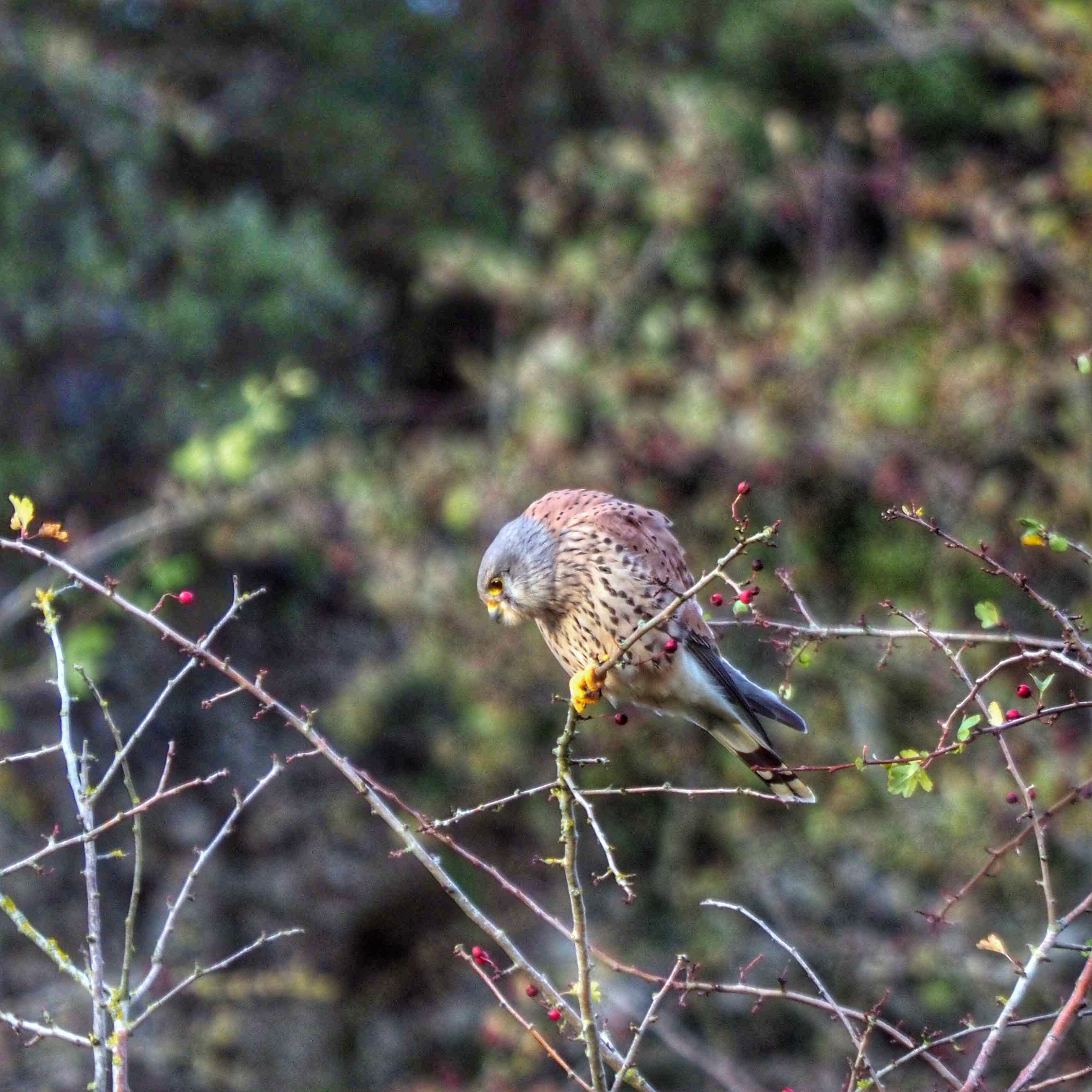
Over the past year or two I have spent a lot of time with Kestrels, initially by accident and then by design. Lockdown started it all, enforced localness meant a concentration on the birds to be found in the lanes and farmland that I could walk to from home. I soon learnt where the good spots were to watch the resident Kestrels and take photos. I found myself going back to these spots in the hope that a Kestrel would be perched up within camera range perhaps doing something interesting like dismembering a small bird or rodent.
Just over a year ago I changed by old Canon DSLR and lenses for a new lighter Olympus camera system and found myself more often with a camera and telephoto lens hanging off my shoulder ready to be pointed at the local wildlife. This opportunistic approach yielded some nice results and meant that walks which from a Norfolk birding perspective might have seemed a bit quiet became richly rewarding when one of the resident birds performed for me.
Taking these pictures and spending a little time with these birds also reminded me of just how smart they are, the males in particular have the most wonderfully intricate plumage with yellow beaks and feet set off against a slate blue head, a speckled chest, a rufous brown back. Their ability whilst buffeted by the wind to hold their heads still as if mounted on a gyroscope as the intently stare at the ground for prey is both impressive and a little scary if you think what it must be like as a small mammal to have one of these top predators hunting nearby.
Kestrels also represent a sense of continuity in my birding life, growing up in north London and cutting my birding teeth in the capitals parks and open spaces, Kestrels were the first bird of prey that I became familiar with. This was a time when to see a Sparrowhawk was an occasional treat both because they were much scarcer then and also because I hadn't developed the birding skills to easily pick them out as they sped by. As for the raptors that I see on a daily basis now in north Norfolk, Marsh Harriers, Buzzards and Red Kites were the birds of my dreams and very occasional treats on local RSPB group coach trips to birding hot spots. Yet now I am more likely to see one of these three species on a casual walk or drive than I am a Kestrel locally.
As Covid restrictions eased I enjoyed the ability to travel a little further afield to some of the birding hot spots close to home: Titchwell, Holkham and Holme. But still I have found myself revisiting my local Kestrel territories camera in hand hoping to snatch some more candid snaps of these enigmatic little raptors.
![]() |
| Male Kestrel keeping its head still despite being blown around by the wind. |
![]() |
| Kestrel on the roof |
![]() |
| A perfect combination of a male Kestrel and freshly opened Oak leaves |
![]() |
| A favourite post to sit on and regurgitate pellets |
![]() |
| Kestrel pellet |
![]() |
| Kestrel inspecting the ground for prey |
![]() |
| Kestrel pulling at the sinews of its prey. |
Monday, 17 August 2020
Reflections, Waterflame and Mirror on the sky, thoughts on a visit to Houghton Hall
Over the past few months eye catching roadside hoardings showing a globe of blue sky streaked with clouds have popped up all over north and west Norfolk. These are advertising an exhibition of landscape art by the famed sculptor Anish Kapoor at Houghton Hall. Being curious and having a week off and two children to keep entertained through this long summer holiday we decided to give the exhibition a try. At £16 each for an adult ticket but free entry for the kids it was a reasonably priced but not cheap excursion.
Houghton Hall doesn't open until 11am which does feel rather late in the day and when we arrived ten minutes early there was a queue of cars waiting by the locked gates. We'd booked our tickets online and when we gave our booking reference to the lady on the entrance booth she remarked that we were "another group" that were booked for the following week, but that she "would let us in". Grateful as we were to be let in we were a little surprised at her tone given we had checked the computer booking and clearly weren't the only folk who had a problem with the date.
Once parked we headed first for the Walled Garden which was wonderful and both kids [age 8 and 11] said this was their favourite place, in particular they loved Jeppe Hein's Waterflame a traditional pond and water fountain topped off by a burning flame. I suspect an analysis of social media posts from Houghton would show this as one of the most photographed and shared parts of the estate.
![]() |
| Jeppe Hein's, Waterflame |
The rest of the Walled Garden was lovely and no1 son in particular was taken by the amount of fruit grown within it. I enjoyed having a coffee on a bench by another pool and spent a contemplative five minutes photographing a Water Lily surrounded by the fallen crimson petals of a Geranium.
![]() |
| Water Lily and Geranium petals |
Passing through the Courtyard [with some above average quality outdoor furniture to sit on] we showed our tickets and entered the grounds in front of the Hall and spent a pleasant couple of hours using the free map provided to explore both the Anish Kapoor exhibition and the permanent pieces of landscape art. The headline act for us and I suspect for most other visitors was the Kapoor piece Sky Mirror. Perhaps a shame it was such a grey day and that the giant sphere reflecting the sky took on the appearance of the Moon rather than the radiant blue and white disc of the promotional posters, perhaps something to consider when deciding when to visit.
![]() |
| Anish Kapoor, Sky Mirror |
Although it was quite busy, unlike most places around where we live in North West Norfolk at no point did we feel crowded and it was easy to relax and find a quiet spot to sit and drink coffee or have a picnic. Our fellow visitors were fun to observe with perhaps not unexpectedly, a higher proportion of folk in slightly more bohemian clothing. One final observation on our experiences and which I only noticed towards the end of our visit was that there were no dogs in the grounds. So no dog muck to avoid, no owners with dogs that they don't quite have under under control that bound up to you barking, which did make a nice and relaxing change.
Our visit ended with an ice cream tub on the lawns [£2 each] whilst a pair each of Red Kites and Common Buzzards jousted high over the Hall.
Sunday, 21 June 2020
Can you ever have too many Avocet pictures?
![]() |
| Avocets, Frampton Marsh |
I enjoyed taking this image, the marsh was full of Avocets and I was having fun trying to get pictures of them in flight. I started to try and make sense of the activity around me by focusing on single birds, but as I became more attuned to the action going on around me, I noticed that often pairs of birds would take flight together or that two or three birds would converge in the air as they chased each other away from their patch of ground.
There is something very elegant about Avocets. Their plumage the crisp lines between the black and white feathers, the long blue grey legs on which they daintily wade through muddy shallows, and that distinctive long black scimitar bill for sifting small shrimps out of the marsh.
Avocets have a suitably tragic and well known back story as a species, a history inextricably linked in with that of the RSPB who have adopted the species as their emblem in acknowledgement of the hope that their work on these birds in helping them to recover from extinction as a breeding bird in the UK. Work that gives hope to their work on other threatened birds.
By dint of where they live and also perhaps where they don't, Avocets will be associated in many birders minds with great days out in amazing places on the coast: Minsmere, Titchwell, Frampton a roll call of our best nature reserves, where today you are almost guaranteed to see these special birds. Hope made real in flesh and feathers, a Lazarus bird brought back from UK extinction and whose spread has been facilitated by the creation of new nature reserves with suitable habitat for Avocets and a range of other wetland birds.
In response to some frustrating behaviour by some photographers, I once heard an exasperated warden exclaim something along the lines of "Aren't there enough pictures of Kingfishers in the world!" Indeed sometimes when leafing through portfolios of award winning images of UK wildlife I have felt the same. But I think on reflection that misses at least part of the point. Taking pictures of Kingfishers, Avocets and a whole range of other species gives people pleasure, it gives them a sense of connection and it can give friends and family pleasure too. All of which I hope leads to a sense that these species and the places that they live are worth looking after.
Taking this picture gave me pleasure, I have taken pleasure from the reaction of others to it over on my Instagram page and I have taken pleasure from the fact that there is more to it than may be apparent on first viewing.
Looking at it I feel that the image has a balletic feel to it, the upper bird appears to be releasing the lower bird to let it swoop elegantly away, as if they were performing some avian version of Swan Lake. And yet that isn't what was happening, this 1600th of a second moment frozen in time is not of two birds in a loving aerial dance, but of a dog fight above a east coast marsh on a mid-summer morning. The Avocets here were in a constant state of agitation, as soon as I opened my car door I was hit by a soundscape full of their kloot, kloot calls as pairs of Avocets chased away their neighbours and any other birds who had the temerity to enter their air space.
In essence they were behaving less like ballerina's and more like badly behaved super models. In doing so they were living up to their reputation as notoriously anti social birds. Thinking back I can vividly remember watching an Avocet colony on a Dutch marsh where one adult bird grabbed a neighbours chick in its delicate bill and throttled it under the water until the young birds parents flew in screaming to rescue it. In Norfolk I have watched pairs of Avocets rising to the sky to harry and chase away birds many times their size including potential predators like Grey Herons.
I witnessed these behaviours and had the chance to grab on film fractions of seconds for posterity, because sitting overlooking a marsh watching the birds, anticipating their behaviour and thinking about technically how I can grab a shot worth sharing, all that gives me pleasure. It also means for me at least that I am even more inclined to want to protect and share the places where these elegant if slightly anti-social birds thrive.
Saturday, 20 June 2020
Hope, Cranes and the Lockdown
![]() |
| Lockdown Cranes, Hunstanton |
Saturday, 16 May 2020
Snapshots of Lockdown from a small east coast town.
The last few days have felt simultaneously strangely familiar and yet disconcerting and worrying. With the relaxation for now of the lockdown restrictions there has been a increase in traffic and people around Hunstanton and the surrounding coast and countryside, still not at the levels we would normally expect but much busier than it has been. With this increase in people out and about, there has also been an increase in rumour, opinion and worry; does the holiday cottage at the end of someones road now have people in it, will we be inundated with folk
this weekend and with them an increased risk of the virus
This shift back towards a more normal number of people and cars is a bit of a jolt we have been lucky living in a relatively sparsely population corner of England. Whilst the Virus is present in the local population we have been able to isolate ourselves and enjoy quiet walks and bike rides, that sense of peace and tranquility and accompanying feeling of relative safety now seems to be fading away and will for a while at least be missed.
Today we went for a walk in our local woods and you could see those small personal judgements made in households, about maybe relaxing social distancing rules just a little bit starting to multiply when applied to the population at large. Groups of four or five teenagers on mountain bikes, inter-generational family groups walking together, workmen standing close together discussing a job. All small personal decisions but when multiplied it makes you wonder whether we will soon see another rise in infections. We have two good local walks which we have been able to lengthen and shorten according to need. One takes us down Lovers Lane along the oak lined track that is Downs Road and then towards Ringstead Downs. The other walk goes along Old Hunstanton Beach towards Holme and then back along the edge of the River Hun past the Golf Course. Since Lockdown began on 23 March I have managed to see or hear 101 species on walks from home mainly on these two routes.
As spring has progressed I have watched as the fields either side of Lovers Lane turned a vibrant shade of yellow as the Oil Seed Rape bloomed and now as the Rape sets seed these fields have faded to green. I have learnt the best fields to search for Wheatear's in Spring and which hedgerows to pause by to listen for the songs of Lesser Whitethroats. On the coast path we have enjoyed watching dueling Green Hairstreaks and basking Wall Brown Butterflies.
It has been these walks on my own and with the family that have helped to keep me fit and sane over the last couple of months, indeed more than that I have enjoyed getting to know the small east coast town that I call home and its surrounding countryside better and watching a season unfold in my local area. 
Soon Spring will give way to Summer, already the swaying hazy white blooms of Cow Parsley have taken over from Alexanders in the hedgerows and soon the Cuckoos will fall silent. Whilst lockdown is being lifted a little for now I will be focused on my home ground and on the walks that I can do from home for some time to come.
I have been trying to post regular pictures and accompanying words on my Instagram account here
https://www.instagram.com/bull_of_the_bog/