Showing posts with label photography. Show all posts

Friday, 8 April 2022

Time with Kes

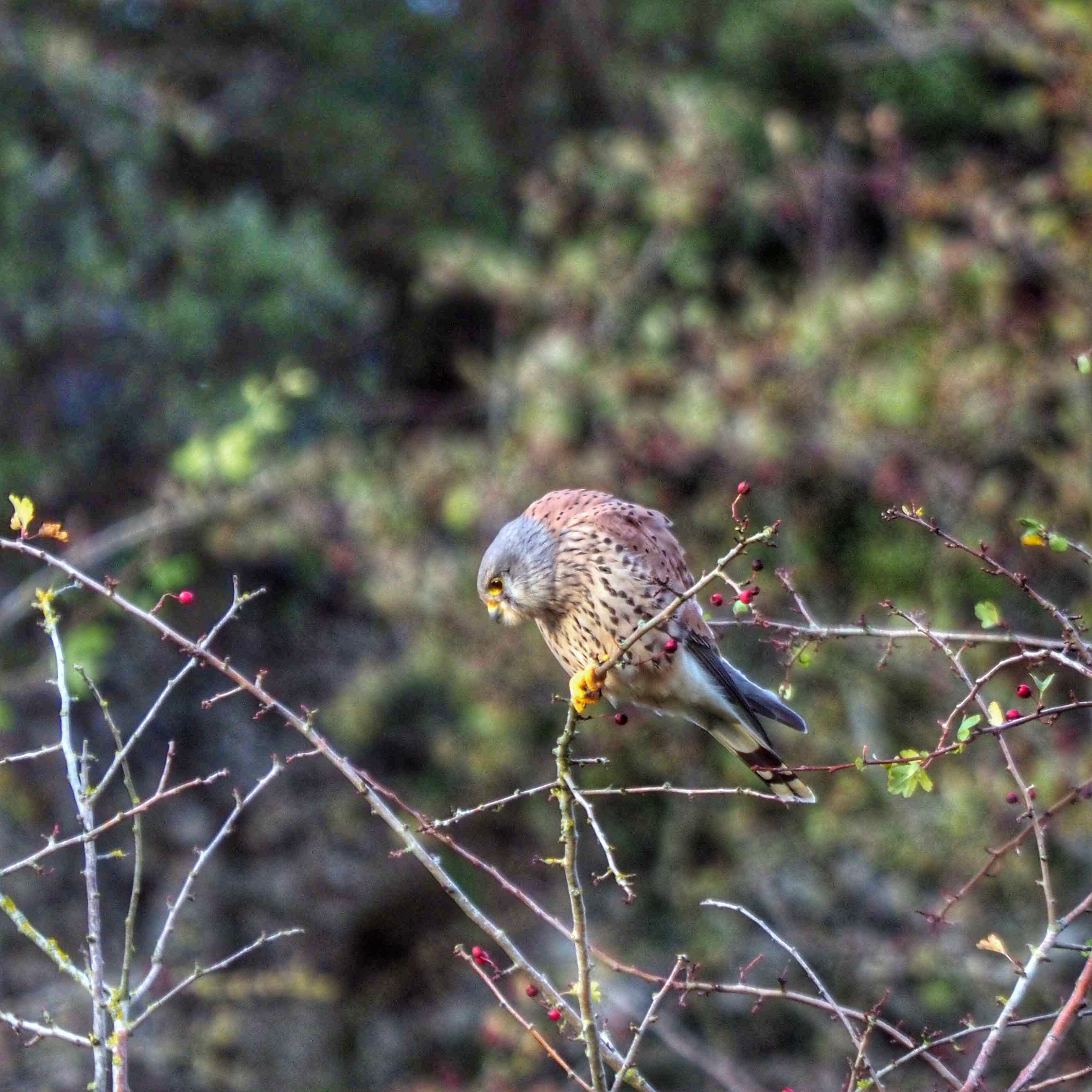
Over the past year or two I have spent a lot of time with Kestrels, initially by accident and then by design. Lockdown started it all, enforced localness meant a concentration on the birds to be found in the lanes and farmland that I could walk to from home. I soon learnt where the good spots were to watch the resident Kestrels and take photos. I found myself going back to these spots in the hope that a Kestrel would be perched up within camera range perhaps doing something interesting like dismembering a small bird or rodent. 

Just over a year ago I changed by old Canon DSLR and lenses for a new lighter Olympus camera system and found myself more often with a camera and telephoto lens hanging off my shoulder ready to be pointed at the local wildlife. This opportunistic approach yielded some nice results and meant that walks which from a Norfolk birding perspective might have seemed a bit quiet became richly rewarding when one of the resident birds performed for me. 

Taking these pictures and spending a little time with these birds also reminded me of just how smart they are, the males in particular have the most wonderfully intricate plumage with yellow beaks and feet set off against a slate blue head, a speckled chest, a rufous brown back. Their ability whilst buffeted by the wind to hold their heads still as if mounted on a gyroscope as the intently stare at the ground for prey is both impressive and a little scary if you think what it must be like as a small mammal to have one of these top predators hunting nearby. 

Kestrels also represent a sense of continuity in my birding life, growing up in north London and cutting my birding teeth in the capitals parks and open spaces, Kestrels were the first bird of prey that I became familiar with. This was a time when to see a Sparrowhawk was an occasional treat both because they were much scarcer then and also because I hadn't developed the birding skills to easily pick them out as they sped by. As for the raptors that I see on a daily basis now in north Norfolk, Marsh Harriers, Buzzards and Red Kites were the birds of my dreams and very occasional treats on local RSPB group coach trips to birding hot spots. Yet now I am more likely to see one of these three species on a casual walk or drive than I am a Kestrel locally. 

As Covid restrictions eased I enjoyed the ability to travel a little further afield to some of the birding hot spots close to home: Titchwell, Holkham and Holme. But still I have found myself revisiting my local Kestrel territories camera in hand hoping to snatch some more candid snaps of these enigmatic little raptors.

Male Kestrel keeping its head still despite being blown around by the wind.

Kestrel on the roof

A perfect combination of a male Kestrel and freshly opened Oak leaves

A favourite post to sit on and regurgitate pellets

Kestrel pellet 

Kestrel inspecting the ground for prey

Kestrel pulling at the sinews of its prey.


Sunday, 17 June 2018

Seasonal Confusion

Saturday morning and in deference to my family tired after a busy week of work, school and after school activities I haven't set my alarm this morning, nonetheless I wake early and slip quietly out of bed and gather my birding kit together for the short drive to Titchwell. 

The first bird that I see as I turn off the A149 into Titchwell Marsh is a Barn Owl briefly gliding across the entrance track, a nice start to my visit.

The reserve is empty with just one other car in the car park, I start my usual early morning circuit heading down the meadow trail for a quick look at Patsy's Pool before heading back around the Boardwalk hoping for some flowering spikes of Marsh Orchids, there  are none, but lots of Ragged Robin and Yellow Flag Iris and it is great to hear and see a couple of Cuckoos as they chase each other around the reedbed and scrub. 

Curlew Sandpiper, Titchwell Marsh
I'd forgotten it was a big tide this morning and it is a pleasant surprise as I approach the Fresh Marsh that the first birds I see are a flock of Dunlin and the first bird in my binoculars field of view is a Curlew Sandpiper just moulting out of its breeding plumage. The Dunlin are great all chestnut brown backs and inky black bellies, I'm never sure at this time of year if the waders are on a late trip north or an early journey south, autumn or spring? Five black summer plumaged Spotted Redshank's add to the value and I have a quick scan and count of the mixed flock of winter plumaged Bar and Black Tailed Godwit, whilst a Greenshank fly's over calling.

Pyramidal Orchid
The fenced predator proof area is a noisy "chaos" of Black Headed and Med Gulls and I find three Little Gulls sitting on the edge of an island. It is good too to see Common, Little and Sandwich Terns here.Whilst a couple of wing pricked Pink Footed Geese walk across the marsh and add to the seasonal confusion is it Spring, Summer, autumn or winter?

Male Kestrel
In the afternoon we decide on a family to the Beach Hut at Brancaster, here we have a walk through the dunes get great views of a hunting male Kestrel and flowering spikes of Pyramidal Orchids which are nicely framed by the yellow flowers and dun coloured seed cases of Yellow Rattle.  On the next door beach hut a pair of Swallows are nesting under the eaves, last year it was a pair of Pied Wagtails and the year before that Swallows. We keep as much distance from the birds as we can so that they can make visits to their nest and I try my luck with some flight photography using a ancient lens and decrepit DSLR body whilst perched in a  Directors Chair.

Swallow

A great day.
Thursday, 5 April 2018

Spring out of the Bottle

Spring is late this year, the Beast from the East and its various pale imitation successors have delayed the arrival of early Summer migrants and to be honest it just hasn't felt that nice out. But with the Easter Bank Holiday weekend safely out of the way the weather took a turn for the better and on Tuesday afternoon I had a walk around Holme Dunes in 12 degrees and with a warm breeze blowing.
Chiff Chaff, Holme Dunes
I knew that there had been a male Black Redstart seen and as I lifted my binoculars to scan a familiar out of focus deep blue shape flitted across my line of sight, a Swallow, soon to be followed by half a dozen others, marvellous. A short walk and I found some Chiff Chaffs feeding in the scrub and there seemed to have been an increase in Stonechat's with at least four present. But best of all were two box fresh totally immaculate male Wheatear's feeding on some short turf.


Wheatear, Holme Dunes
 Still no sign of the Black Redstart and I had almost given up when a movement in the distance caught my eye and I had a brief glimpse of it on a fence wire perhaps 50 metres from where it had last been reported. I walked round for a better view and managed a couple of shaky handheld digi-scoped shots before what proved to be a very skittish bird moved off.

Black Redstart, Holme Dunes
Then the light left the sky and it started to spit a cold rain, this rapidly increased in volume and size of rain drops and I took partial shelter under the pines whilst a heavy cold squall passed through.

This morning I managed a couple of hours out using the car as a mobile hide on the local back roads. It was slow going at first but for the last half hour before I needed to get home to look after the kids, the sun came out and the wildlife action hotted up. Highlights were large numbers of summer plumage Brambling's in the hedgerows, a Bran Owl flying into a hole in an old oak tree presumably its nest site? and a Little Owl standing sentry by a break in an Oak branch, another nest site?

Brown Hares
A Marsh Harrier quartering a field close to the road watched by a wary Hare was the final bird before I had to make a speedy drive home.

Marsh Harrier

Sunday, 4 March 2018

Feeding Wild Owls


Barn Owl waiting for food
I used to know a one eyed Barn Owl in Kent. If I positioned myself on the birds blind side it would fly really close to me, before when it turned its head and good eye in my direction it saw me, at which point I could see the bird panic as it  banked sharply and rapidly flew away. This individual owl stands out in my memory not because it only had one eye, but because it came so close, a rare thing for wild Barn Owls.

Scroll forwards a couple of decades and I'm sitting in a curry house in Holt, north Norfolk with my friend David  who is talking about a friend of his who feeds Barn and Tawny Owls in his garden "flocks of them, up to eight or nine in the air at once."

I'm intrigued and a little sceptical at first, but I trust my friends bird knowledge and know slightly the person he is talking about. As the curry and lager goes down I ask if it would be possible to see this spectacle for myself and bring my young family along. My friend has a think for a moment and then says that he'll make a call and see what he can arrange.

Which is how a few weeks later I find myself in a large garden come scrubby meadow with my friend and his daughter, our host, my wife and our two young boys. It is freezing and the arrival of the bad weather soon to be known as the "Beast from the East" is just a couple of days away.

Earlier sitting in our hosts lounge we'd already seen video footage of the Barn Owls in their nest site in his roof and now we have come outside into the cold night air with a bag of dead day old chicks, several of which have now been placed on carefully positioned dead tree branches.

Above us in sharp silhouette against the sky and stars a barn owl fly's silently round the field, looking down at us, eyes set in its large round head held aloft by long white wings. Looking up I get a sense of what it must be like to be a vole in this same meadow when one of these top predators is hunting.

But this evening the owls are not hunting but scavenging, our host supplementary feeds "his" birds helping them to fledge two broods last summer. In this unique setting and in accepting this free source of food the birds have also become habituated to people. Nonetheless this gathering of seven people is the most that they have experienced and our host is cautious about the effect that this might have on the owls behaviour.

There are now three owl's flying around above us in a ghostly holding pattern. The kids for the moment forget the cold and excitedly point out the circling Barn Owls.

Barn Owl getting a free meal
I focus my camera on a dead day old chick that has been placed on a branch less than three metres away from where we are standing. I pop up my cheap DSLR 's inbuilt flash, I'm ready, just as well because one of the tamer owls decides that it is safe to come in for food. It descends quickly, wings held high and legs stretched forwards talons ready to grasp a dead chick. Although we all know we should be quiet an excited chatter accompanies the birds rapid descent and departure. I don't think that any of us visitors had expected that, a wild owl coming in quite so close.

Over the course of the next 15 to 20 minutes (I didn't check the time) two more Barn owls come in to grab a free meal and another shyer pair watch from high in a tree waiting for us to move on before they come down for their food.

Our host decides that we should turn around and move a few metres to where we can view another dead branch that he has planted in the grass of his meadow garden. Here on the edge of some scrubby trees he hopes we will see the Tawny Owl that he feeds.

Now there used to be a one eyed wildlife photographer who lost an eye when he was returning to a hide on a Tawny Owl nest late one night. His name was Eric Hosking and he had his accident way back in May 1937 before the advent of modern camera gear. I'd heard his story many times and had never quite understood how it could have happened. But on this cold Norfolk evening it became a lot clearer to me how such an accident might have occurred.

Our hosts Tawny Owl was usually later to put in an appearance than the Barn Owls and it wasn't on its normal perch waiting to be fed when we had arrived earlier in the evening. Maybe there were too many of us. Now gathered together we stood even closer to the bait than we had for the Barn Owls and as for them there were some basic lights rigged to illuminate the scene. Somewhere in the darkness we could hear a Tawny Owl hooting, a more familiar and less other worldly sound than the screeching of the Barn Owls.


Tawny Owl with supplementary food
Then in the time it took to utter a warning "here it comes" the resident Tawny Owl shot towards us in a fast low level flight out of the dark and straight to the dead chick, talons outstretched wings up to brake. One flash of the camera and it was gone as suddenly and as quietly as it had arrived.

Now having seen the speed and power of a bird I normally only see dozing in a tree during its day time roost, I could better understand how Eric Hosking could have lost his eye in a speedy attack by a Tawny Owl defending its nest.

The cold is starting to rise through our feet and permeate our bones, one child tired, excited and cold goes back to the car to warm up. Another declares that they need a trip to the loo. So reluctantly we decide to call it a night and turn to leave. Just as our bodies are at 45 degrees to the perch with a dead chick on it a Tawny Owl bursts from cover and repeats the rapid flight in and out we'd seen earlier.

Maybe not the flocks of owls I'd been promised over a curry, but a truly remarkable experience nonetheless. We thank our host and climb into the car to drive home with his admonition ringing in our ears to drive carefully and not hit any of his owls.

Sunday, 4 February 2018

Front

Its easy to work out the points of a compass at Titchwell the coastline runs east to west and the West Bank Path runs from North to South, so if you are standing on the beach facing the sea you are looking due North. This morning the view from the top of the Dunes was of a choppy North Sea with a perishing cold wind cutting through exposed flesh and the waves making it hard to pick out of sea duck. 

I made my way to the top of the highest dune and had a quick scan of the beach but could just see the to be expected mix of Oystercatchers, Sanderling and Bar Tailed Godwit's, whilst the sea seemed a little devoid of birds. 

View east from Titchwell towards Brancaster Beach and Scolt Head
Looking East towards Scolt Head Island and the Royal West Norfolk Golf Club at Brancaster I could see a weather front coming in. Above me the sky was still blue with sunshine, to my east it had turned black, dark clouds edged with silver inexorably moving in my direction.

My fellow birders eyes were focused on a narrow field of view in front of them, the beach for shorebirds and sea for wildfowl and all seemed oblivious of the approaching bad weather. I decided to turn  around and head back down the West Bank path as I did so the cloud caught up with me and gone was the blue sky of an hour ago, Island Hide was illuminated by a spotlight of sunshine breaking through the clouds and was fronted by a rim of golden reeds. On a small island half a dozen Red Crested Pochard sat hunkered down heads tucked under wings to keep warm.

Red Crested Pochard, Titchwell
Beyond the hide a pair of Marsh Harriers buffeted in the wind did a half hearted little bit of courtship over the reedbed but buffeted by the wind soon went their separate ways.

Island Hide, Titchwell
A return walk over the same route in just under an hour but with two very different views.

Monday, 29 January 2018

Light

December is a month of short dark days, weeks that compete for gloominess and a month that seems to shudder to a halt with the indoor excesses of Christmas. Yet just a week or two later as the days  start to draw out in the new year there is a also a subtle change to the quality of the light. Now on sunny days it has a vibrancy that was missing in December and comes with a gentle hint of the Spring to come. 

Ken Hill Woods last Friday, I quite liked the light
Last Friday was just such a day of promise, a clear night left a heavy morning frost that coated the cars windscreen with a thin layer of ice. In the local woods at lunchtime a bumblebee sat in a stupor on the ground woken to early from its winter sleep, the vibrant yellow flowers of a Gorse bush were out a little early for pollinators like the unfortunate bee. As I enjoyed my walk snatches of Great Tit and Nuthatch song cut through the trees, whilst a large mixed flock of Long Tailed Tits, Goldcrests and Coal Tits reminded me that this was still January.

But it was something about the light on a woodland ride and how it brought out the colours of the bare trees that made me stop in my tracks and pull out my little compact camera. To the left of the ride sunlight streamed through a gap in the trees, creating a natural spotlight at 45 degrees. This light hit the bronze leaf litter on the forest floor and reflected back up onto the white bark of the silver birches that edged the ride. Behind all this a belt of conifers suffused with the same winter light gave a soft green background to the scene.

This viewpoint is one that I have passed many times before, it is on one of my favourite walks through these woods, a walk I do probably at least once a week throughout the year. It is pleasant but it doesn't normally having me pausing and reaching for my camera. But today what for me briefly lifted the scene was the light helping me see a different view and bringing this bend in a path in the woods to life.


As I stood and tried to capture an image that would go someway to capture the spirit of the scene in front of me, I was acutely aware of the transient nature of what I was enjoying. All it would take for the magic to fade would be a change in the position of the sun as the afternoon wore on, or a light breeze pushing in some cloud and with it turning off the magical soft winter light.

I carefully composed my image and pressed the shutter button, then after taking one last look at the scene in front of me continued my walk around the wood and eventually back to my office and a full afternoons work at my computer.

Sunday, 7 May 2017

Photographing Quicksilver, a little time with Swifts

Sunday and with a decidedly chilly weather forecast we decide on a family walk along the landward side of the pines between Holkham and Burnham Overy Staithe. Part mobile football match, part birdwatch and part picnic we make our way along a surprisingly quiet path heading west from Lady Anne's Drive.
Female Wheatear, Burnham Overy Dunes
I didn't have any great birdy expectations apart from getting to add Spoonbill to my year list and sure enough we saw a number of these around the Cormorant colony as expected. The only other year tick was a Greenshank that I picked up as it called as it flew over whilst we had our picnic in the dunes.

Male Wheatear, Burnham Overy Dunes
The dunes didn't hold any Ring Ousels that I could find and in the cold northerly wind migrants were thin on the ground so two or three Wheatear's were nice to see and included a very tame female that allowed me to shuffle within a couple of metres of her.

Swift, Burham Overy Staithe
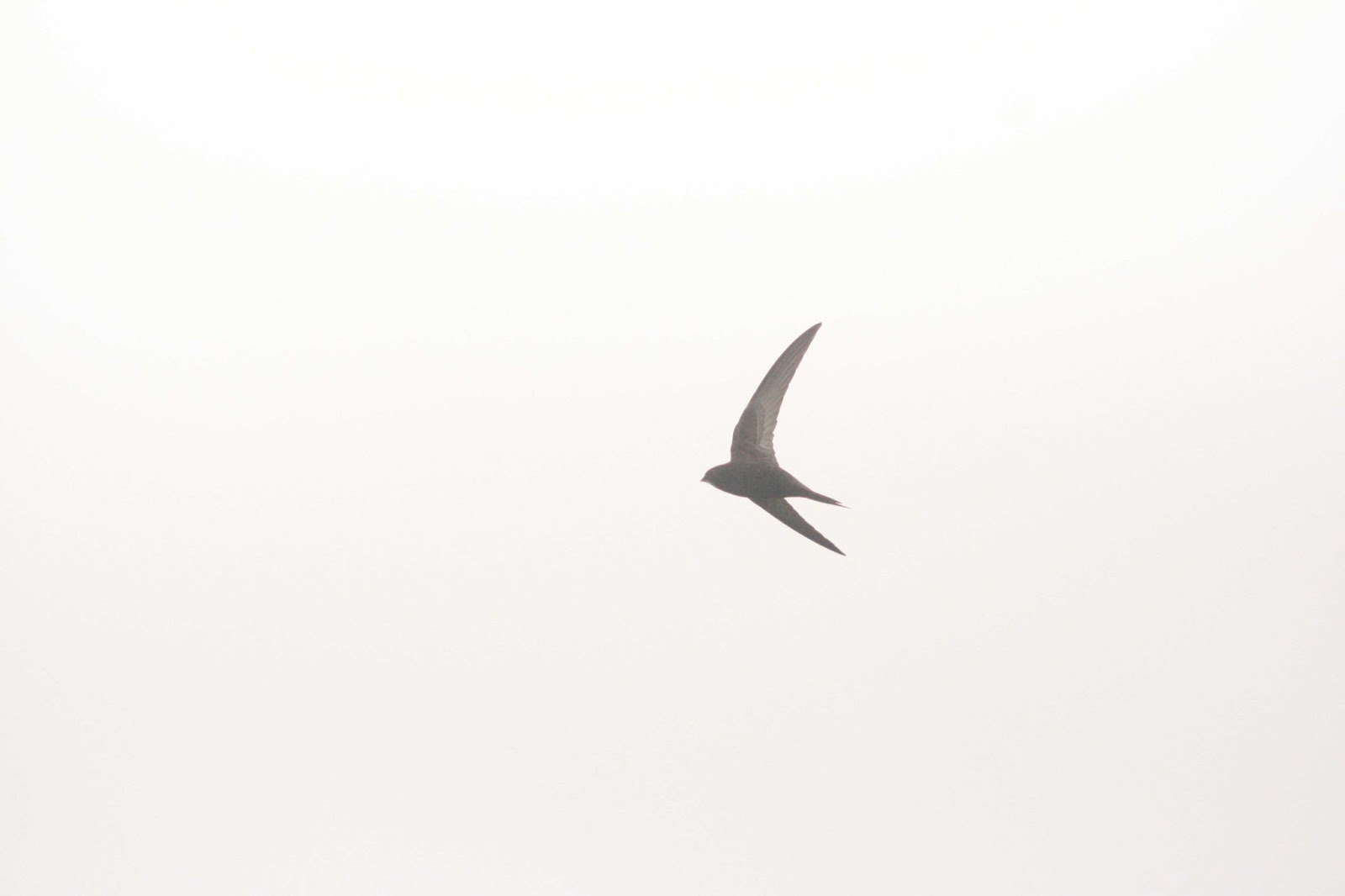
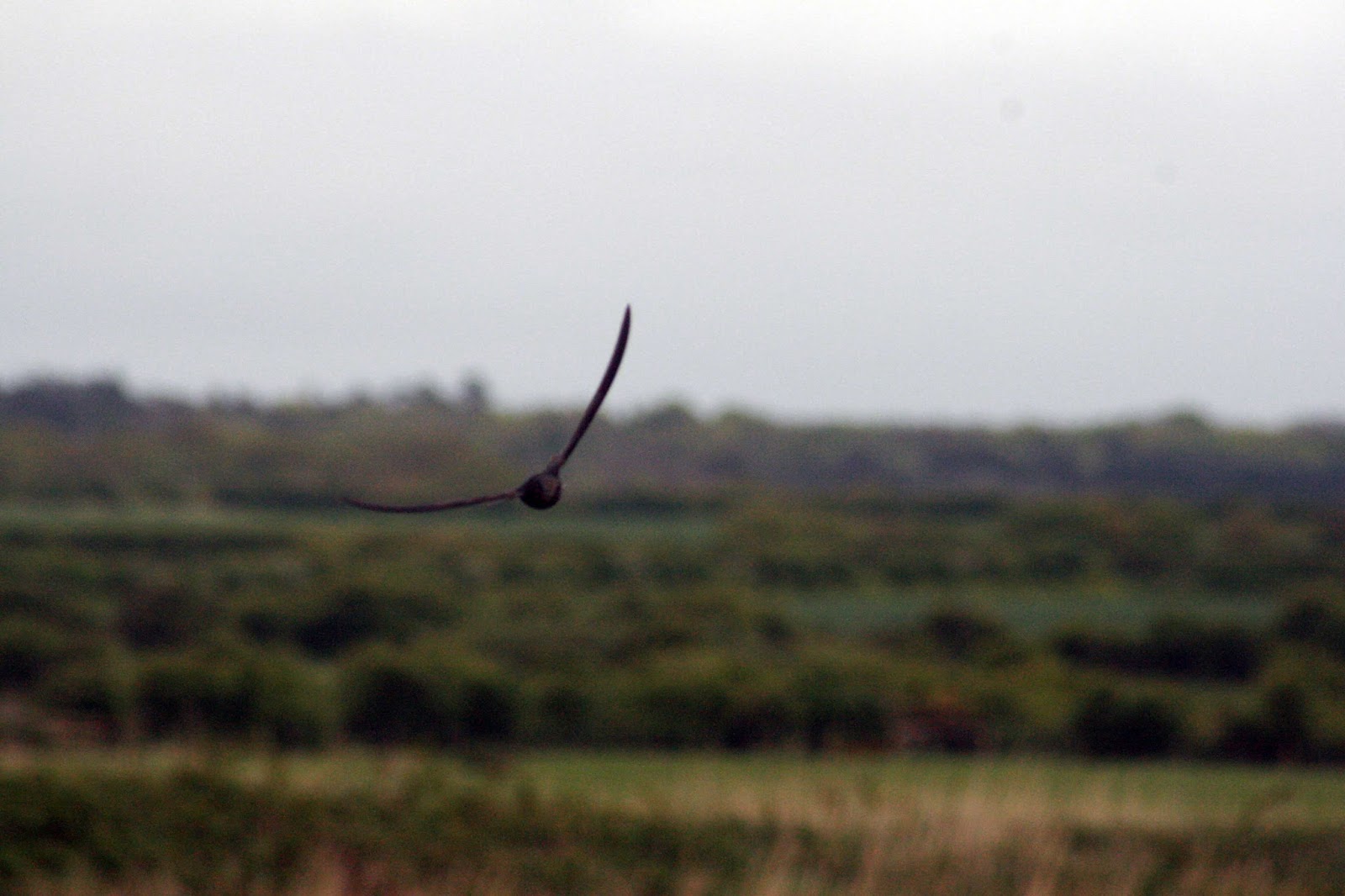
As we walked on the landward side of the seawall back towards Burnham Overy Staithe, large numbers of Swifts buzzed around our heads and I got sucked into one of my favourite summer pastimes trying to photograph Quicksilver aka as Swift photography. I really didn't have the right kit with me a ten year old EOS 400D body and an even older Canon  100 - 300 mm 1; 4.5-5.6 lens the auto focus on which wheezed slowly in and out far more slowly than the Swifts moved through the sky which made the already tricky task of photographing them much harder.

Swift, Burham Overy Staithe
Nonetheless I had a great time, Swifts are such charismatic birds and so unpredictable in flight, just when you think that you that you and your camera have finally focused on one, it does a sudden shimmy and is gone. One eagerly anticipated moment when photographing Swifts, never guaranteed and never predictable, is when one fly's so close to your face that you can hear the rush of air through its wings and for a second you wonder if its wing brushes against you, will slice your ear off.

Swift, Burham Overy Staithe
I took lots of shots, most were out of focus, but one or two were OK as record shots and I have shared a few here.

Swift, Burham Overy Staithe
Whilst waiting for the Swifts this male Kestrel worked its way down the sea bank and for a moment or two was almost directly overhead an din good light. A very pleasant twenty minutes.


Saturday, 6 May 2017

Full Sum Plum - Male RB Fly at Holme

I noticed on the Birdguides Norfolk page yesterday that there had been a Red Breasted Flycatcher at Holme and was pleasantly surprised to find that it was still present today. After a morning spent in the home office catching up on important and all to frequently prevaricated bits of personal admin, I set off early afternoon for the short drive along the coast to Holme Dunes.

A typical view of a bright bird on a grey day, Red Breasted Flycatcher, Holme
As I drove down the bumpy access track I stopped to talk to my friend Trevor who was just leaving and had seen the bird who assured me it was pretty straightforward as it was showing in the car park to a small crowd. He also told me that there were some Wheatear's, a male Redstart and a Whinchat in one of the paddocks.
Red Breasted Flycatcher, Holme
Having parked a car I walked the twenty or so yards to the assembled birding gallery and very quickly had the bird in my binoculars and managed some very poor record shots. At this point it flew off high into some pines and I decided to head to the paddock where I quickly had scope views of a couple of Wheatears, a Whinchat and lovely Male Redstart. 

Back to the NWT car park where the male Red Breasted Flycatcher had returned and with patience I managed some slightly better if still record only quality shots [all the images in this blog are heavily cropped] as it busily moved through the trees occasionally sitting still for a few seconds, often with it s back turned before continuing its restless feeding. 

Red Breasted Flycatcher, Holme
It really was in great plumage red throated and silver faced. As the afternoon progressed a steady turnover of folk and one or two friends unexpectedly put in appearances which turned this mini twitch into a pleasant social occasion too.
Full frontal, Red Breasted Flycatcher, Holme

Thursday, 27 April 2017

Spring Waxwings

Late April and the Bird Guides Norfolk page continues to carry news of a flock of Waxwings on the outskirts of Norwich, I realise that they are hanging a round a retail park and industrial estate just off the A47 on my way home and that I haven't seen a Waxwing this year.
Waxwing, Norwich

The next morning I pull off the A47 and have a drive around the industrial estate but no joy, its a big place and I could do with directions, fortunately a colleague spent Sunday morning watching the birds and is able to sketch a map for me on a piece of scrap paper.
Waxwing, Norwich

Properly equipped I revisit the industrial estate and soon find the birds or rather they find me as they fly over my car. As soon as I get out I can hear their wonderful trilling call and by arching my neck I can see half a dozen Waxwings in the tree above me. Soon they take flight across the road and back to some berry bushes to feed and I am able to get close enough wit a old 100 - 300mm zoom lens to take a few snaps, the lights isn't great but it is still lovely to be so close to these birds.
Waxwing, Norwich

Fittingly the weather is wintry with grey cloud a cold wind and occasional showers, I wonder if they will still be here in a weeks time when the first returning Swifts could be flying overhead?

Sunday, 12 March 2017

Watching Turnstones, turn stones

Turnstone, Holme Beach
I spent a pleasant hour this morning on Holme Beach with the family. It was a grey morning with a hint of rain in the air, despite this and the relative remoteness of the location there were still a fair number of folk out and about with all the usual issues of disturbance to the wildlife you are trying to watch or photograph by their dogs.

Whilst the kids had a play in the sand I focused my attention and rather slow and very old 100 - 300 zoom on a Turnstone that was feeding on the strand line. By approaching the bird carefully and avoiding any sudden movements I was able to get a few nice shots and also to observe it's feeding technique.
Turnstone doing exactly what its name suggests it should do
At first it was working its way through some seaweed and I thought of its old Norfolk name of Tanglepicker, then it moved up the beach onto some dryer sand and started feeding there. It did this by turning over stones and probing deep into the sand with its beak, whenever it removed its face from the sand and turned to face me the birds forehead was covered in a sandy mask.

Turnstone searching for food
What impressed me though was the strength of its neck muscles, it would rapidly move between pebbles, quickly inserting its beak at their base and with a twist and flick of its neck turn the stone over, often flicking stones that looked like they weighed more than the bird into the air, quite impressive.
Turnstone, Holme Beach

I like Turnstones, they are adaptable and approachable and if a bird can have character I think they have it in spades, they are in trouble too with a declining population. You can read more about Turnstones in this excellent blog Why do Turnstones eat chips

Sunday, 25 September 2016

Turnstone Action

I'm lucky I live about five minutes walk from Hunstanton beach which means that if ever I have an hour spare I can take my binoculars and camera for a walk and enjoy some great wildlife. I have developed a couple of mild photographic obsessions based around the beach. The first is the nesting Fulmars who provide lots of opportunities to practice my flight photography and I am slowly getting some better quality images of these great birds.
Turnstone, Hunstanton Beach
The second are the Turnstones that live up to their name flicking over the pebbles on the beach and squabbling over scraps of food.

Today I saw from the weather forecast that there was a good chance that the sun would break through the cloud at about 5pm and I managed my day around getting away for a hour or so late afternoon.

When I got to the beach I noticed that the area under the seawall was free of walkers and also had lots of Herring Gulls and Turnstones feeding there. I quickly found the colour ringed Turnstone I was hoping to record [more about them another time] and realised that I could use the Groyne as a makeshift hide allowing me to crouch within six feet of the feeding Turnstones.

Turnstone and Juvenile Herring Gull, Hunstanton Beach
As I watched the birds feed using their beaks and necks to flick over pebbles, grabbing open mussels and teasing out the contents, I realised that there seemed to be a conflict avoidance behaviour going on. Birds would shrilly call at other birds that came to close, normally enough for one bird to then back off, but occasionally there would be a flurry of wings as two birds jousted for food.

Turnstones arguing over food, Hunstanton Beach
It did seem a little odd that there should be any fighting as there seemed to be no shortage of open mussel shells for both the Turnstones and the Herring Gulls present to feed upon.

Turnstones arguing over food, Hunstanton Beach
I had a great hour and a bit with these birds, the light was more miss than hit with just a few moments of golden light. But now I have discovered by Groyne Hide I will be back again trying to get better shots.

Friday, 26 August 2016

Gannet action at Bempton

A place where the sound of birds rises above and dominates the east coast wind, where the fishy smell generated by tens of thousands of defecating birds pervades the air, and where a line of white cliffs cuts out into the blue of the North Sea. The RSPB's nature reserve at Bempton Cliffs is all of these things and the most easily accessible large seabird colony in England. Each year I try and make a visit to take in the spectacle of the colony in full flow and this year I was lucky enough to spend a few hours there at the end of July.

Part of RSPB Bempton Cliffs
Tree Sparrows bounced around the bushes surrounding the new Visitor Centre where I was able to grab a welcome coffee and slice of cake. I see Tree Sparrows every year but I am not aware of anywhere in Norfolk where I live where they are so easily seen around bird feeders in and in such good numbers. I love their rich chestnut caps and the black beauty spot on their cheeks.

Tree Sparrow
Caffeinated we set off down the well made path to the cliffs, normally I visit earlier in the Spring and there was a noticeable difference in the birds on view compared to my normal mid April visits. I had to work hard to see Guillemots and Razorbills, apparently the majority of these two species of Auks had finished breeding and left the cliffs the week before, Shags too were thin on the ground. But Puffins were everywhere, on the sea, flying in front of the cliffs and perched below the viewpoints. Apparently late July is just about the best time to see Puffins at Bempton.

Bempton Puffins

But the undoubted stars of the show were the Gannets, many with well grown fluffy chicks on the rocky cliff ledges below the viewpoints, these majestic Persil white seabirds would drift along the cliff tops a few metres away from you. My travelling companion was quite overwhelmed and wanted to add the use of the sens of touch ti that of hearing, smell and sight by reaching out to hold one. Perhaps the most entertaining Gannet action was on a grassy slope near the top of the cliffs where a constant succession of birds came in and landed to grab beak fulls of grass to start the process of making next years nests.

Bempton Gannet and nesting material
All along the cliff top trail were well presented and informative hand drawn chalk boards with key facts about the seabirds. At the southernmost viewpoint I spotted one of the resident peregrines high overhead a great bird to end our walk with.
Peregrine at Bempton

Back at the Visitor Centre I graduated from my morning coffee to a afternoon Ice Cream and then the long drive home.

Sunday, 31 January 2016

Rough Legs in the Gloom

The rain eased off mid afternoon and I managed to get out in the car for a quick drive to do an errand in Brancaster Staithe via a couple of birding sites. From Hunstanton I took the back road past Courtyard Farm and whilst I didn't find any Little Owls a large mixed flock of Corn Buntings and Yellowhammers was good value.
Crap Rough Legged Buzzard picture

I turned north up Chalkpit Lane and stopped before the summit of the hill. I quickly got distance views of a Rough Legged Buzzard and after a few minutes I was watching two birds "tumble" along the hedgerow in the distance, one bird flying up into a bare tree to be followed shortly afterwards by the second birds, I couldn't work out his this was a pair of birds bonding, fighting over territory or a bit of pre-roost socialising. Eventually they went their separate ways and I managed some very grainy " record shots" which I have heavily manipulated on the computer to get anything even vaguely usable.
An another
From here I swung down into Brancaster Staithe Harbour and had a pleasant ten minutes with the long staying Red Necked Grebe which was joined by a trio of Red Breasted Mergansers. As the light faded and the ISO setting on my camera got cranked ever higher I tore myself away and headed for my errand in Brancaster and then home.

Red necked Grebe

Red Breasted Mergansers