Tuesday, 4 August 2026

Common, Blue, Beautiful

I took this picture at the weekend Whitlingham Country Park, probably the busiest wetland in Norfolk, a place where people go to literally re-create themselves, through a myriad of outdoor activities from running to sailing, birdwatching to photography, walking the dog, picking Blackberries and much more.

Common Blue Damselfly

This place was until the turn of the century a sand and gravel quarry. Then after landscaping it opened to the public in 2004, a new blue green lung for Norwich and a new Broad over 700 years after our ancestors peat diggings that when they flooded became the Norfolk Broads we know and love today.

Those original wetlands have had centuries to develop layers of ecological complexity, Whitlingham is newer and it’s ecology will develop in the years to come.

But Whitlingham is still a wetland and full of life, including common but stunning creatures like this Common Blue Damselfly, who's company those who visit and who take a moment to pause and stare into the wild and the wet can enjoy.

Friday, 31 July 2026

Shifting baselines and a Red Backed Shrike

The first time I can remember seeing a Red Backed Shrike was when I was working in the Scottish Highlands during the summer of 1990, a singing male had been reported somewhere near Loch Ruthven and I was given a lift to see the bird on the simple condition that I kept the news secret.


Male Red Backed Shrike, Roydon Common


By 1990 the baseline for Red Backed Shrike in the UK was of a very rare breeding bird, nowhere regular with pairs breeding occasionally around the country one year and not returning the next, and whose presence had to be kept secret from egg collectors and anyone else who might disturb them.

Yet not so very many years before I started birding in the 80s, they would have been regarded as a widespread and familiar bird of the countryside, they even had a well-known colloquial name, Butcher Bird, on account of their habit of impaling prey on thorn bushes. That was the baseline an early 20th century birder would have been familiar with.

These days I regard any day that I see a Shrike as a good one, an occurrence that with luck I might experience two or three times a year. That’s the early 21st century Red Backed Shrike baseline.

So, when a summer plumaged male turned up at Roydon Common a few miles from my house recently I didn’t take long to decide that I wanted to go and see it.

I arrived at the Common after work in lovely soft, golden summer evening light, and quickly found a group of half a dozen birders standing around where the bird had last been seen.

After an uncertain and mildly stressful few minutes the bird was relocated, and we were soon able to enjoy the Shrikes company as it hunted for spiders in the heather and scrub. As folk having seen the bird started to chat the conversation became a living history of the species fortunes and changing perceptions of its status over the last half century.

One birder happy with the views he’d had fell into conversation with me, he remembered when he first started birding “...they still nested around here” and gestured vaguely in the direction of the Brecks where the last regular breeding pair in England hung on until the late 80’s. For him they had once been a regular but special part of his youthful summers. Something that I guess made the evening twitch to see this lone passing bird all the more poignant an experience.

Why did they disappear? Perhaps an answer can be found in The Netherlands from where my Dutch birding mate Arnold messaged me to say that “Red Backed Shrike was almost gone from the Netherlands years ago, but they are making an impressive comeback. They are back on the coast where I live too. So good hopes for the UK I guess”! But why?

The evidence would seem to suggest that where localised recovery in Shrike numbers has happened in The Netherlands it is because the conditions have been created to increase the amount of large insect prey, they depend upon.

So perhaps as we strive to create bigger areas of more resilient habitat in the UK we too will one day have created the conditions to encourage passing Red Backed Shrikes to stop and redraw their baseline in the English countryside as a regular breeding summer visitor.

But until that happens, I will just have to content myself with the occasional treat watching migrating Shrikes around my home on the Norfolk coast.

Saturday, 23 May 2026

Otterly Splendid

After over 30 years of walking Titchwell's trails and West Bank path I don't often get to see something new for this special corner of the Norfolk coast. Today I'd got to the reserve relatively early and as the temperature started to rise and the light became ever hazier I started to wander back towards where my car was parked near the Visitor Centre, pausing briefly to take a picture of The Warden of the Marshes a  Redshank, perched high on some saltmarsh vegetation alert for predators.

Otter West Bank Path, RSPB Titchwell Marsh

I could see a birder wandering along the path towards me and my brain immediately recognised the familiar shape and walk of my old friend Digi-Scoping Dave. Like so many people in the birding community the last time our paths had crossed was on this 2 metre wide strip of path that heads directly north towards the sea. We greeted each other and had a rambling chat, catching up on each other's health and wellbeing and that of our mutual acquaintances, the weather and what was about. But being birders our brains were not 100% focused on each other and the conversation and we were both distracted by a commotion over the Fresh Marsh when all of the Black Headed Gulls nesting on Island Hide's green roof took flight and wheeled around our heads in a noisy flock. 

Thinking out loud I uttered the entirely predictable line "What's caused that?" as Dave and I, with close to a century of birding experience between us went into automatic scan the sky for a predator mode. Who knows we might even get lucky with something a little unusual, perhaps a migrating Osprey or a hunting Hobby scything through the blue summer sky.

Bizarrely after a few seconds we couldn't see the expected large gull or bird of prey. Dave was the first to lower his gaze and soon had my attention when he immediately announced "There's an Otter!". Again I initially deployed my decades of experience of looking at wildlife, and glanced at the lagoon on the grounds that was where you would expect to see an Otter, only to realise that this Otter was in fact wandering down the main West Bank Path towards us completely unfazed by our presence. Eventually it deigned to take notice of our presence and slipped down the vegetated bank towards the lagoon only to reappear a few seconds later its head poking out from the grass verge. Then after a minute of checking us out it ambled across the path, over the seawall and disappeared into deep cover on Thornham Marshes saltings.

I could have missed this Otter if I'd relied on my instinctive search patterns triggered by the behaviour of the resident nesting gulls. Not because I wouldn't have eventually looked at the path where the Otter was walking towards me, but because by the time I stopped searching the sky for the cause of the commotion the Otter might have slipped away. 

Now I've seen a few Otters over the years, perhaps most memorably on the river in Thetford where a couple of well grown cubs chased a large brown chicken and caused it to panic and decide that the way to escape their attention was to plunge head first into the river, this was a bad thing from the chickens perspective as the Otters followed it into the water and they and the chicken soon disappeared below the surface. When I think back about the conversations I had in the 1990's when for a year I lived and worked at Strumpshaw Fen on the banks of the river Yare and never saw an Otter, and the wardens discussed the disappearance of Otters some years before from the river due to a pollution incident, it really is heartening to see their return. Indeed I half expect to see an Otter these days when visiting the Broads. I just hope Titchwell's latest residents continue to focus on eating the plentiful supply of fish at Titchwell and leave the nesting Avocets alone.

There is a lot of chatter at the moment about AI and its uses, misuses and risks and opportunities. How it feeds off data and learns from patterns and comes up with responses as a result. But how would it cope when the data doesn't make it onto a database, when the information it has tells it to advise looking up at the sky, this would lead to a self reinforcing pattern with no data gathered from other directions and a sloppy distorted view of what to do would emerge, or as I'm not an expert on AI maybe not. But I do have some expertise in watching birds and wildlife and know that as well as recognising patterns, being able to read a landscape and animal behaviour, I've also learnt to anticipate what might happen next based on my brain constantly weighing up the information it is receiving from my senses enabling me to adjust my behaviour as a result. 

So if for example I am watching the Avocets on the Fresh Marsh at Titchwell I know when something exciting is about to happen by their behaviour and what they might be about to do, meaning I can get my camera settings ready to try and capture the moment. 

Black Headed Gull and Avocets, RSPB Titchwell Marsh


Dave and I watched the Otter disappear over the seawall and the Gulls settle back on their nests another enemy seen off and a few minutes calm before the next panic. I headed back to the Visitor Centre where Trevor was showing someone a Spotted Flycatcher, too rare a sight these days but a common in the London Park I birded in my youth. So I had experience of what the bird might be doing where and what to look for.  I immediately scanned the tall trees overlooking the VC and there it was, where I expected it to be sallying forth from a dead wood snag at the top of the trees to catch flies, my sophisticated in built AI, aka brain, had long ago learnt its most likely behavioural pattern and helped me get onto this special little bird quickly. 


Saturday, 7 February 2026

Simon Busuttil an appreciaton

When I started drafting this note on Monday, I really wasn’t sure how to begin and as the week has passed finding an ending has proved similarly challenging. 

On Monday morning I opened up my emails, and one quickly caught my eye, one of those emails with someone’s name the solitary occupant of the subject line. Deep inside I knew that emails like this can hold the worst possible news, but even so as I raced down the page, my brain was searching for a scenario that didn’t hold the message that I was starting to fear. 


Sadly, the news in this email was shockingly bad, Simon Busuttil, my friend and colleague of over 30 years, had died suddenly and unexpectedly at the weekend. Simon was based on the Turks and Caicos Islands [TCI] in the Caribbean, running a portfolio of RSPB conservation projects. 

When we met in London last summer it was clear to me that he was loving life in TCI and full of plans for the future. Simon and I first met in 1991 at Loch Garten, then got to know each other a few years later when he was RSPB Site Manager at Dungeness in Kent. There in the old low-ceilinged rooms of Boulderwall Farm we plotted a five-week expedition "Wings Over Kazakstan" through the Ili River delta in Kazakhstan. A journey that took us and four other English birders through a wetland twice the size of Kent, a boat trip 20km across a large lake in a couple of small aluminium boats with tiny outboards, where a sea monster was reputed to eat the bodies of drowned fishermen (that or it was big, deep and remote and there was no one around to find the bodies) and we “enjoyed" a very messy night in a campsite in the middle of nowhere when our guides tried (successfully) to get us drunk on homemade Vodka that smelt vaguely of bananas and we retaliated with a bottle of duty free Grouse. 

Our RSPB careers took us to different parts of the UK, Simon to Aberdeen to manage the RSPB’s reserves in East Scotland and me to Norfolk. But we kept in touch, attended each other’s weddings, and just before my first son was born had a trip to Spain together where we marvelled at the vast flocks of wintering Cranes and spent a bitterly cold dawn listening to the squeaking door song of Dupont’s Lark.

Simon revelled in people and places, whether the shingle peninsular of Dungeness, the Montrose basin from where he’d tell me about the skeins of wild geese flying over his house in winter, or in more recent years the people and places of his adopted Caribbean home in the TCI. 

When Simon moved with his family to the Caribbean our friendship played out on WhatsApp, only last week we exchanged messages and photos. And whenever he was in the UK, we’d meet up usually in Chinatown for a all you can eat buffet and afternoon talking squit in a London Boozer. When we met last summer, I remember how happy he was as a south London boy and lifelong Crystal Palace fan to have seen them lift the FA Cup earlier that year. 

And so, to the shocking news contained in that email of his untimely death. Gone way to soon with so much left to do and a family to watch grow up. Whenever we met at some point the conversation always turned to our families, and Simon with that familiar glint in his eye would come alive as he updated me on Emily his wife, his two boys and daughter. I never had any doubt that he loved every moment of watching his boys become young men, becoming independent and holding their own in conversation with him, and the extra time he was looking forward to having with his daughter, his youngest child, as the boys left home. 

And I know that if I’m going to miss my mate “Busty” hugely, that I can’t even begin to imagine the hole his passing will leave in his wife Emily and their children's lives. 

Another one of the good guys gone.

Sunday, 6 July 2025

Of Greenfinches and time travel


The parched summer lawn is more faded yellow than green, the arid look slightly lessened by patches of small yellow flowers, a far cry from the manicured but lifeless green carpet we inherited when we moved here two years ago. Looking through the kitchen window as I potter preparing lunch, I spot a Greenfinch working its way across the grass, its thick beak nimbly processing seeds to small for me to see, but immensely reassuring to know that the finch can find.


Greenfinch in a West Norfolk Garden

As I look at this small bird with its understated green feathers and yellow flash in its wing, I am for a moment taken back in time to one of my earliest bird memories, to our tiny north London garden where my mother had hung a red netting bag of peanuts to feed the birds and I think more importantly to her to feed my evident interest in all things wild.


This bag of nuts had initially proved to be a great success attracting a procession of Greenfinches over the fence and into our garden from the over grown garden.


But then Monty discovered the joys of watching the Greenfinches in our garden. Indeed I think is fair to say with hindsight that Monty was even keener on watching the birds on the feeder than I was. Monty was what these days folk are want to call part of the family, back in the early 70's we simply called him a pet. Monty was our slightly mangy Tom cat, black all over apart from a slight wisp of white hairs under his chin, and Monty took a real shine to the Greenfinches on the red netting feeder. And so over the course of a week or so the ground under the feeder had a fall of beautiful green and yellow feathers land on it, as Monty worked his way through the flock with a surprising efficiency.


As I looked out on our Norfolk garden lawn it was gratifying to see not only the Greenfinch feeding on the grass but also Woodpigeons, Blackbirds and a Dunnock and remembering the visits by Green Woodpeckers, a bird of such exotic appearance that the child looking out on that North London garden couldn't even have dreamed of seeing one.


Why do these birds grace us with their presence? Well in part it is because we have provided some of the things that they need, cover to dash into if a predator should appear, a source of food; seeds for the finches, ants for the Green Woodpeckers, and worms and caterpillars for the Blackbirds.


Looking out of the upstairs window the estate we live on looks less inviting to birds than it could do, there are few mature trees and hedges, there are some patches of lawn, but a lot of lifeless paved areas too. But in short, if you try and think like a Blackbird or a Greenfinch it is nowhere nearly as attractive as it could be and gardens like ours are welcome Oasis where birds come to feed. And for us it's a simple investment in pleasure, the pleasure that comes from sharing our lives with these birds, seeing them and hearing their songs.


The Greenfinch looks settled, so I rush and grab my camera, I ease open the kitchen window and gingerly poke the long lens through the gap and grab a few shots. Greenfinches really are such smart birds, I can see with clarity even after all these years why they captivated the younger me.


But it's a work day and lunch is ready and after grabbing a few shots, I return to the kitchen table to eat and think about that tiny north London garden half a century and a lifetime ago.

Friday, 8 April 2022

Time with Kes

Over the past year or two I have spent a lot of time with Kestrels, initially by accident and then by design. Lockdown started it all, enforced localness meant a concentration on the birds to be found in the lanes and farmland that I could walk to from home. I soon learnt where the good spots were to watch the resident Kestrels and take photos. I found myself going back to these spots in the hope that a Kestrel would be perched up within camera range perhaps doing something interesting like dismembering a small bird or rodent. 

Just over a year ago I changed by old Canon DSLR and lenses for a new lighter Olympus camera system and found myself more often with a camera and telephoto lens hanging off my shoulder ready to be pointed at the local wildlife. This opportunistic approach yielded some nice results and meant that walks which from a Norfolk birding perspective might have seemed a bit quiet became richly rewarding when one of the resident birds performed for me. 

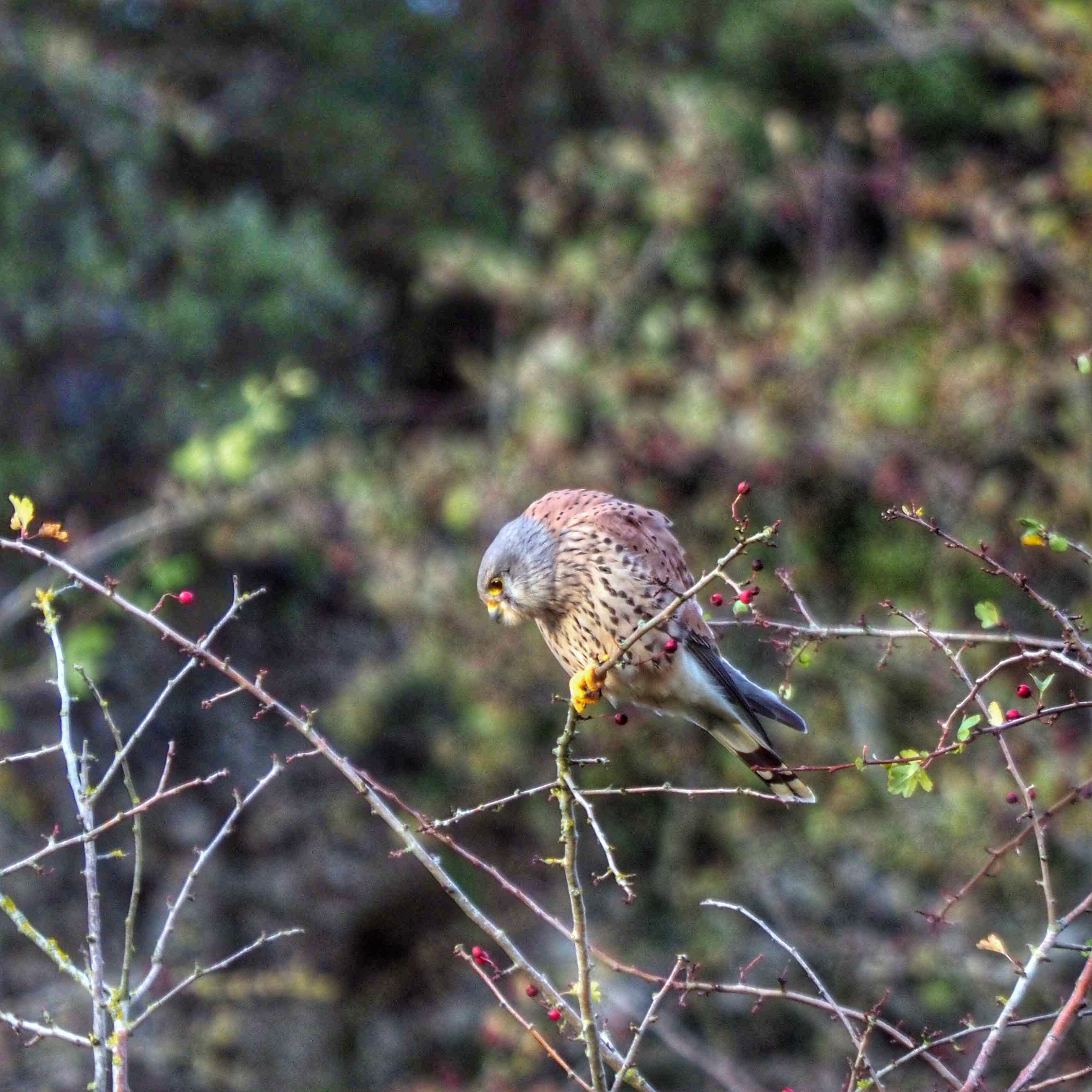
Taking these pictures and spending a little time with these birds also reminded me of just how smart they are, the males in particular have the most wonderfully intricate plumage with yellow beaks and feet set off against a slate blue head, a speckled chest, a rufous brown back. Their ability whilst buffeted by the wind to hold their heads still as if mounted on a gyroscope as the intently stare at the ground for prey is both impressive and a little scary if you think what it must be like as a small mammal to have one of these top predators hunting nearby. 

Kestrels also represent a sense of continuity in my birding life, growing up in north London and cutting my birding teeth in the capitals parks and open spaces, Kestrels were the first bird of prey that I became familiar with. This was a time when to see a Sparrowhawk was an occasional treat both because they were much scarcer then and also because I hadn't developed the birding skills to easily pick them out as they sped by. As for the raptors that I see on a daily basis now in north Norfolk, Marsh Harriers, Buzzards and Red Kites were the birds of my dreams and very occasional treats on local RSPB group coach trips to birding hot spots. Yet now I am more likely to see one of these three species on a casual walk or drive than I am a Kestrel locally. 

As Covid restrictions eased I enjoyed the ability to travel a little further afield to some of the birding hot spots close to home: Titchwell, Holkham and Holme. But still I have found myself revisiting my local Kestrel territories camera in hand hoping to snatch some more candid snaps of these enigmatic little raptors.

Male Kestrel keeping its head still despite being blown around by the wind.

Kestrel on the roof

A perfect combination of a male Kestrel and freshly opened Oak leaves

A favourite post to sit on and regurgitate pellets

Kestrel pellet 

Kestrel inspecting the ground for prey

Kestrel pulling at the sinews of its prey.


Monday, 17 August 2020

Reflections, Waterflame and Mirror on the sky, thoughts on a visit to Houghton Hall

Over the past few months eye catching roadside hoardings showing a globe of blue sky streaked with clouds have popped up all over north and west Norfolk. These are advertising an exhibition of landscape art by the famed sculptor Anish Kapoor at Houghton Hall. Being curious and having a week off and two children to keep entertained through this long summer holiday we decided to give the exhibition a try. At £16 each for an adult ticket but free entry for the kids it was a reasonably priced but not cheap excursion. 

Houghton Hall doesn't open until 11am which does feel rather late in the day and when we arrived ten minutes early there was a queue of cars waiting by the locked gates. We'd booked our tickets online and when we gave our booking reference to the lady on the entrance booth she remarked that we were "another group" that were booked for the following week, but that she "would let us in". Grateful as we were to be let in we were a little surprised at her tone given we had checked the computer booking and clearly weren't the only folk who had a problem with the date. 

Once parked we headed first for the Walled Garden which was wonderful and both kids [age 8 and 11] said this was their favourite place, in particular they loved Jeppe Hein's Waterflame a traditional pond and water fountain topped off by a burning flame. I suspect an analysis of social media posts from Houghton would show this as one of the most photographed and shared parts of the estate. 

Jeppe Hein's, Waterflame

The rest of the Walled Garden was lovely and no1 son in particular was taken by the amount of fruit grown within it. I enjoyed having a coffee on a bench by another pool and spent a contemplative five minutes photographing a Water Lily surrounded by the fallen crimson petals of a Geranium. 

Water Lily and Geranium petals

Passing through the Courtyard [with some above average quality outdoor furniture to sit on] we showed our tickets and entered the grounds in front of the Hall and spent a pleasant couple of hours using the free map provided to explore both the Anish Kapoor exhibition and the permanent pieces of landscape art. The headline act for us and I suspect for most other visitors was the Kapoor piece Sky Mirror. Perhaps a shame it was such a grey day and that the giant sphere reflecting the sky took on the appearance of the Moon rather than the radiant blue and white disc of the promotional posters, perhaps something to consider when deciding when to visit. 

Anish Kapoor, Sky Mirror 

Although it was quite busy, unlike most places around where we live in North West Norfolk at no point did we feel crowded and it was easy to relax and find a quiet spot to sit and drink coffee or have a picnic. Our fellow visitors were fun to observe with perhaps not unexpectedly, a higher proportion of folk in slightly more bohemian clothing. One final observation on our experiences and which I only noticed towards the end of our visit was that there were no dogs in the grounds. So no dog muck to avoid, no owners with dogs that they don't quite have under under control that bound up to you barking, which did make a nice and relaxing change. 

Our visit ended with an ice cream tub on the lawns [£2 each] whilst a pair each of Red Kites and Common Buzzards jousted high over the Hall. 


Sunday, 21 June 2020

Can you ever have too many Avocet pictures?

Avocets, Frampton Marsh

I enjoyed taking this image, the marsh was full of Avocets and I was having fun trying to get pictures of them in flight. I started to try and make sense of the activity around me by focusing on single birds, but as I became more attuned to the action going on around me, I noticed that often pairs of birds would take flight together or that two or three birds would converge in the air as they chased each other away from their patch of ground.

There is something very elegant about Avocets. Their plumage the crisp lines between the black and white feathers, the long blue grey legs on which they daintily wade through muddy shallows, and that distinctive long black scimitar bill for sifting small shrimps out of the marsh.

Avocets have a suitably tragic and well known back story as a species, a history inextricably linked in with that of the RSPB who have adopted the species as their emblem in acknowledgement of the hope that their work on these birds in helping them to recover from extinction as a breeding bird in the UK. Work that gives hope to their work on other threatened birds.

By dint of where they live and also perhaps where they don't, Avocets will be associated in many birders minds with great days out in amazing places on the coast: Minsmere, Titchwell, Frampton a roll call of our best nature reserves, where today you are almost guaranteed to see these special birds. Hope made real in flesh and feathers, a Lazarus bird brought back from UK extinction and whose spread has been facilitated by the creation of new nature reserves with suitable habitat for Avocets and a range of other wetland birds.

In response to some frustrating behaviour by some photographers, I once heard an exasperated warden exclaim something along the lines of "Aren't there enough pictures of Kingfishers in the world!" Indeed sometimes when leafing through portfolios of award winning images of UK wildlife I have felt the same. But I think on reflection that misses at least part of the point. Taking pictures of Kingfishers, Avocets and a whole range of other species gives people pleasure, it gives them a sense of connection and it can give friends and family pleasure too. All of which I hope leads to a sense that these species and the places that they live are worth looking after.

Taking this picture gave me pleasure, I have taken pleasure from the reaction of others to it over on my Instagram page and I have taken pleasure from the fact that there is more to it than may be apparent on first viewing.

Looking at it I feel that the image has a balletic feel to it, the upper bird appears to be releasing the lower bird to let it swoop elegantly away, as if they were performing some avian version of Swan Lake.  And yet that isn't what was happening, this 1600th of a second moment frozen in time is not of two birds in a loving aerial dance, but of a dog fight above a east coast marsh on a mid-summer morning. The Avocets here were in a constant state of agitation, as soon as I opened my car door I was hit by a soundscape full of their kloot, kloot calls as pairs of Avocets chased away their neighbours and any other birds who had the temerity to enter their air space.

In essence they were behaving less like ballerina's and more like badly behaved super models. In doing so they were living up to their reputation as notoriously anti social birds. Thinking back I can vividly remember watching an Avocet colony on a Dutch marsh where one adult bird grabbed a neighbours chick in its delicate bill and throttled it under the water until the young birds parents flew in screaming to rescue it. In Norfolk I have watched pairs of Avocets rising to the sky to harry and chase away birds many times their size including potential predators like Grey Herons.

I witnessed these behaviours and had the chance to grab on film fractions of seconds for posterity, because sitting overlooking a marsh watching the birds, anticipating their behaviour and thinking about technically how I can grab a shot worth sharing, all that gives me pleasure. It also means for me at least that I am even more inclined to want to protect and share the places where these elegant if slightly anti-social birds thrive.


Saturday, 20 June 2020

Hope, Cranes and the Lockdown


Context is hugely influential in how we experience and think about nature and 30 odd years ago for me as a young birder that meant a frame of reference formed by the London parks where I had done most of birdwatching. On this occasion though I wasn’t in London, but with a friend who lived close to the Norfolk Broads. We were standing at the end of bitterly cold and snowy winters day on the edge of the marshes with the distinctive shape of Horsey Mill behind us. A family party of Whooper Swans had just flown past, Marsh Harriers were drifting over the large reedbed and then there they were bugling as they went by a pair of Cranes. To me back then these were mythical creatures, part of a tiny population of pioneering birds recolonising this wild eastern edge of England. Soon they disappeared from view as they dropped into their night-time roost site.

So when one evening this April, several decades later and in a different corner of Norfolk, two Common Cranes appeared over the rounded slope of the arable field I was walking past, not only did I feel the excitement I always experience when seeing these majestic birds, but they also triggered memories of that first sighting in the Broads and some of the work that I have been involved in over the years with RSPB to help create places where Cranes if they so choose can live and thrive.
Lockdown Cranes, Hunstanton

The Cranes as they flew past me high and heading north were unmistakeable large grey birds with long legs and necks topped by a red heads. I had thought that given the lockdown restrictions it would be many months until I got the chance to travel into Crane country, and it was this sense of them as an unexpected and short lived treat that made this experience all the more special. The birds were soon gone, my encounter with them lasting less than a minute, time to relish the moment and grab a couple of record shots with my camera. Then once they were out of sight I sent a text to a friend who lived half a mile away suggesting they get out in their garden in case they could see them from there. The message I got back was an unhappy one, pointing out that they had walked past the same field twenty minutes earlier and no they couldn’t see or hear the Cranes from their garden.

Cranes were once a widespread bird of the British Countryside, but like so much else of our native wildlife they disappeared from the landscape and our national consciousness centuries ago, victims of hunting and habitat loss. Then something amazing occurred they found their way back. Initially this happened slowly in remote marshland in the Norfolk Broads, where pioneering birds started their nesting attempts in the late 70’s on the Horsey estate. Slowly as this population grew in size, it started to expand its range across the Broads and then into the Fens where the first Cranes to nest in this famously flat landscape in four centuries chose to do so at the RSPB’s Lakenheath Fen Nature Reserve.

Now Lakenheath Fen is an amazing place to visit hooching with life on a spring day. This is a man made landscape,  a small restoration of the once extensive wild and wet Fens that were drained for agriculture. Until they were drained the Fens were England’s great wetland, but the drainage not only sucked water out of the fens but also wildlife. Then back in the early 1990’s the RSPB’s East Anglian region team based in Norwich were looking to buy a piece of land in the Fens that could be used to create a new wetland nature reserve away from the coast and the threat of sea level rise, where species like Bitterns and Marsh Harriers could thrive. Never in their wildest dreams did they think that within a couple of decades Cranes would be nesting on the wetland they created. Following an appeal the RSPB were able to buy the land for this project at Lakenheath, land which at the time it was being used to grow carrots. To lead the task of turning 400 hectares of carrot fields into a wetland they appointed Norman Sills as warden. Norman had spent the previous couple of decades setting up the famous RSPB nature reserve at Titchwell Marsh on the north Norfolk coast and is a bit of a genius when it comes to taking a piece of land and creating a wildlife rich wetland.

Today you can take the train from Brandon past Lakenheath Fen, a journey across arable fields until you pass the reserve, a landscape of swaying reeds over which glide Marsh Harriers and if you are lucky you may catch a glimpse out of the train window of one of the reserves two pairs of Cranes.

In 2010 whilst the Cranes in eastern England, in the Fens and the Broads, were slowly building up their population a partnership called the Great Crane project made up of WWT, RSPB and Pensthorpe Conservation Trust, with major funding from Viridor Credits Environmental came together to give our wild Crane population a boost in the west of England on the Somerset Levels. Here on England’s largest area of wetland and grazing marsh, a landscape criss-crossed by dikes and marshes dotted with grazing cattle over a five year period 93 Cranes were released into the wild by the project.

Helped by nature conservation organisations, landowners and other’s Cranes have done well in England in recent decades slowly reclaiming bits of the landscape their ancestors would once have occupied. A sort of long-legged giant Canary in a coalmine, whose presence is a symbol of where landscapes are wet enough and wild enough to have these birds back. They show where, as a society, we have been able to make space for nature, not just for Cranes but for the wild ecosystem’s and nature friendly farmland on which they rely.

Last year there were an amazing 56 pairs of Cranes nesting across the UK, and although their strongholds are still in the Broads, Fens and Somerset Levels birds can be found in other areas too. At least 85% of the UK population of Cranes are found on protected sites with a third of these on RSPB nature reserves, wild places where they can breed undisturbed safe away from people.

All of which means that at a time when because of lockdown my physical horizons had shrunk to the places I can easily reach on foot from my house. I was able to stand by the side of a non-descript arable field, on the edge of the small east coast town that I call home, with a pair of Cranes briefly adding some sparkle to my daily exercise walk and for the Cranes to remind me that when people come together we can bring nature back into our landscapes and our lives.

After the Cranes have flown out of sight over the wood to my north, I scribble the record in my notebook and remember the late American writer and explorer Peter Matthiessen’s book Birds of Heaven about his journeys around the globe in search of the worlds different Crane species. In this book he coins a lovely phrase to describe those of us who like him are smitten by these elegant and enigmatic birds and the wild places where they live, he called himself and us Crainiacs, I like that.

Saturday, 16 May 2020

Snapshots of Lockdown from a small east coast town.


The last few days have felt simultaneously strangely familiar and yet disconcerting and worrying. With the relaxation for now of the lockdown restrictions there has been a increase in traffic and people around Hunstanton and the surrounding coast and countryside, still not at the levels we would normally expect but much busier than it has been. With this increase in people out and about, there has also been an increase in rumour, opinion and worry; does the holiday cottage at the end of someones road now have people in it, will we be inundated with folk 
this weekend and with them an increased risk of the virus

This shift back towards a more normal number of people and cars is a bit of a jolt we have been lucky living in a relatively sparsely population corner of England. Whilst the Virus is present in the local population we have been able to isolate ourselves and enjoy quiet walks and bike rides, that sense of peace and tranquility and accompanying feeling of relative safety now seems to be fading away and will for a while at least be missed. 

Today we went for a walk in our local woods and you could see those small personal judgements made in households, about maybe relaxing social distancing rules just a little bit starting to multiply when applied to the population at large. Groups of four or five teenagers on mountain bikes, inter-generational family groups walking together, workmen standing close together discussing a job. All small personal decisions but when multiplied it makes you wonder whether we will soon see another rise in infections. 

We have two good local walks which we have been able to lengthen and shorten according to need. One takes us down Lovers Lane along the oak lined track that is Downs Road and then towards Ringstead Downs. The other walk goes along Old Hunstanton Beach towards Holme and then back along the edge of the River Hun past the Golf Course. Since Lockdown began on 23 March I have managed to see or hear 101 species on walks from home mainly on these two routes. 

As spring has progressed I have watched as the fields either side of Lovers Lane turned a vibrant shade of yellow as the Oil Seed Rape bloomed and now as the Rape sets seed these fields have faded to green. I have learnt the best fields to search for Wheatear's in Spring and which hedgerows to pause by to listen for the songs of Lesser Whitethroats. On the coast path we have enjoyed watching dueling Green Hairstreaks and basking Wall Brown Butterflies. 

It has been these walks on my own and with the family that have helped to keep me fit and sane over the last couple of months, indeed more than that I have enjoyed getting to know the small east coast town that I call home and its surrounding countryside better and watching a season unfold in my local area. 

Soon Spring will give way to Summer, already the swaying hazy white blooms of Cow Parsley have taken over from Alexanders in the hedgerows and soon the Cuckoos will fall silent. Whilst lockdown is being lifted a little for now I will be focused on my home ground and on the walks that I can do from home for some time to come.

I have been trying to post regular pictures and accompanying words on my Instagram account here 
https://www.instagram.com/bull_of_the_bog/

Monday, 2 September 2019

Summer's last Hurrah


Bank Holiday Monday and I sit with my coffee in an East Coast town. An old boy pauses to speed smoke, sending out wafts of grey smog as he stares intently at the Vape shop opposite. A waitress in a fresh apron hurry’s by. The air is warming up, its going to be a sweaty one. My coffee has gone time to finish the dog walk. 

In the cliff top gardens there is a collection of fantastic beasts masquerading as windmills. Beyond them The Wash England's wildest place it's alive with fantastic beasts you just need to look. 


The morning expands and we head for the Kayak man's stall on the prom to rent a couple of boats for a paddle.


Summers last Hurrah on The Wash, a flat Sea merging into a clear pastel blue sky. In front of us a new pink outcrop pokes out into the sea as hordes of beach goers edge into the cool waters. My boys and I paddle on into summers end. 

My small east coast town faces west into the sunset, a chilled end of Bank Holiday crowds gather to watch the sun slide into the waters of The Wash with barely a ripple as a late water skier rips through the sea and Oystercatchers pipe in the twilight. Nature soothes the throng. 


Back in my street neighbours discuss the day, its been busy, all along the coast car parks have been full and everywhere cars have been abandoned blocking roads as day trippers like Eels heading for the Sargasso sea show an unstoppable desire to migrate to the soothing waters of the North Sea.


Sunday, 4 August 2019

Crab on the menu

We are in the middle of a series of big spring tides at the moment. This morning I walked along the West Bank Path at Titchwell, the Fresh Marsh to my east stuffed full of migrating Shorebirds including half a dozen delicate Wood Sandpipers delicately picking insects from the surface of the shallow lagoon. Out in the middle of the Fresh Marsh 14 Spoonbills were doing what Spoonbills seem to like to do best, sleeping. 

Wood Sandpiper, Titchwell Marsh
To my west was the expanse of saltmarsh that lies between Titchwell and Thornham Harbour, the incoming tide creating pools that reflected the bright blue August sky and which were rimmed by the purple flowers of Sea Lavender. A Curlew picked its way through this salty meadow and I paused to take a photo that would capture the bird and its high summer home. 

Curlew, Titchwell Marsh
As I watched the Curlew caught a crab in the tangle of submerged vegetation and held it firmly at the end of its long down curved bill, I wondered how it would manage to transfer the small crustacean, which was frantically and ineffectually waving it's limbs, down into its stomach. Several times it managed to manoeuvre the crab half way up its bill before having to start again as the crab wiggled back towards the tip of the bill and survival. Then with one last effort the Curlew suddenly had the crab at the top of it mouth and then it was gone, still wriggling down its throat. 

Curlew, Titchwell Marsh
The Cormorants in the dead trees in the reedbed by Patsy's Pool sat still in the early morning warmth their black feathers presumably exacerbating for the them the warmth of the rising summer sun. 

Cormorant, Titchwell Marsh

Saturday, 20 July 2019

Beach Life

Sitting on the edge of The Wash at Snettisham as the sun starts to drop down the western horizon and offshore children enjoy a summer sail in the Sailing Clubs Toppers, I am reminded what a wonderful place this is for people to come and relax. Parents are scattered along the beach chilling as their kids are taught to sail. In the distance I can see a large family group walking along the tide line occasionally skimming stones and throwing a stick for the family dog. A older couple walk past hand in hand with cameras round their necks in search of a sunset shot to share on social media. Everyone seems happy and contented in using this special place for quiet recreation and sharing it with others. 

Adult Ringed Plover on guard duty, Snettisham

Yet I am on tenterhooks, I have noticed on the shingle ridge to my left a young Ringed Plover, almost fully grown but not yet able to fly. It has wandered out of the section of beach that the Warden has roped off to protect ground nesting birds like Ringed Plovers and Oystercatchers. Out here on the open beach, it can do under the watchful eyes of its parents what Ringed Plovers have always done, search for its food of small invertebrates amongst the seaweed and shells on the tide line. I'm worried because whilst it can run it can't fly and as I watch it and its two siblings I see a dog coming towards, us its presence even outside the fenced area enough to send two anxious adult Oystercatchers into the air noisily trying to distract the potential predator from their nest. 

Nearly fledged Ringed Plover chick, Snettisham

And this is the challenge that birds like these face, perfectly adapted for nesting on exposed beaches where the land edges into the sea, they are struggling to cope with increased human use of our coastline. Add in the effects of climate change meaning increased flooding in the breeding season and coastal erosion of their nest sites and the population of Ringed Plovers in Norfolk has nosedived by about 80% in recent decades. Suddenly this small trio of baby "Ringo's" are of much more importance. 

Adult Ringed plover and two well grown chicks, Snettisham

I stop and chat with the dogs owner who has got it on a lead and knows all about the Ringed Plovers and shares my concern for them. We have a pleasant conversation and then they continue on their way and I go back to dividing my attention between the Ringed Plovers and my son sailing lesson. 

Children learning to sail [and fall in], Snettisham